Transforming Movement: More Than Just Exercise

When we think about exercise, we often think about getting fitter, losing weight, building strength or looking after our physical health.

But movement can offer us so much more than that.

What if going for a walk wasn’t just about getting your steps in, but about clearing your head after a difficult day?

What if ten minutes of stretching wasn’t “not enough”, but exactly what your body needed?

And what if movement wasn’t something you had to force yourself to do because you ate too much or missed a workout?

For me, movement is about much more than exercise. its about how it makes me feel.

When You’re Stressed, Your Body Feels It Too

Have you ever had one of those days where your mind just won’t switch off?

Your thoughts are racing, your shoulders feel tense, you’re tired but wired, and even when you finally sit down, you don’t feel relaxed.

Stress doesn’t just affect our minds. We can feel it physically too.

This is one reason movement can be so helpful.

Something as simple as going for a walk can give you the chance to step away from whatever has been overwhelming you. You change your surroundings, get some fresh air and give your mind something else to focus on.

You don’t need to run five miles or complete an intense workout.

Sometimes, a gentle walk around the block is enough to change how you feel.

And I think we often forget just how powerful those simple things can be.

You Don’t Have to Exercise to Exhaustion

There can be so much pressure around exercise.

We’re constantly told to push harder, burn more calories, get more steps and work towards the next goal.

But more isn’t always better.

If you’re already exhausted, stressed and running on empty, another punishing workout might not be what you need.

Maybe you need to slow down.

Maybe you need some gentle yoga.

Maybe you need to walk in the sunshine.

Maybe you need to dance around the kitchen while making dinner.

Movement doesn’t have to look a certain way to count.

It doesn’t matter whether you’ve been to an expensive gym or walked around your local park. Moving your body can still be a positive act of self-care.

Movement Can Help You Feel More Grounded

There is a reason you can sometimes return from a walk feeling completely different from when you left.

Physical activity can support our mood and help us manage stress. But there’s something else about movement that I particularly love.

It can help us get out of our heads and back into our bodies.

We’re often thinking about yesterday, worrying about tomorrow and trying to keep up with everything that needs doing.

Movement can bring us back to the present moment.

When you’re walking, you might notice the trees, the weather, the sounds around you, your breathing or simply the feeling of your feet touching the ground.

You don’t have to turn it into a mindfulness exercise.

Just being outside and paying attention to what’s around you can be surprisingly grounding.

What If You Don’t Feel Motivated?

This is something I hear all the time:

“I know I should exercise, but I just can’t motivate myself.”

And honestly, I don’t think you always need motivation.

Sometimes you just need to make the first step really small.

Don’t tell yourself you’re going to complete a one-hour workout.

Tell yourself you’re going to put your trainers on and walk for ten minutes.

If you want to carry on, great.

If you don’t, that’s okay too.

Ten minutes still counts.

And sometimes, once you’ve started moving, you’ll naturally feel like doing a little more.

The hardest part can simply be getting started.

Movement Can Support Better Sleep

Sleep, stress, movement and our overall wellbeing are closely connected.

When we’re stressed, sleep can suffer. When we don’t sleep well, we can feel tired and unmotivated. And when we’re exhausted, exercise can be the last thing we want to do.

It can become a cycle.

Regular movement can be one piece of the puzzle, helping us stay active during the day and supporting healthier sleep habits.

Again, it doesn’t need to be extreme.

A walk after dinner.

A few gentle stretches.

A little movement during the day when you’ve been sitting for too long.

The aim isn’t to create another thing on your “must do” list.

It’s about finding small things that support you.

Let’s Stop Thinking About Exercise as Punishment

This is something I’m particularly passionate about.

Exercise shouldn’t be a punishment for eating a piece of cake.

You don’t need to “burn off” your dinner.

You don’t have to earn your food.

Food and movement don’t need to be tools for guilt or punishment.

Your body needs food for energy and nourishment. It also benefits from movement for strength, mobility, fitness and overall health.

These things can work together beautifully when we take guilt out of the equation.

Instead of thinking:

“I need to exercise because I ate too much.”

Try:

“I’m going to move because I want to look after my body.”

That small change in language can completely change how we think about exercise.

Find Something You Actually Enjoy

If you hate running, you don’t have to run. There are so many ways to move your body that you will enjoy:

  • Walking
  • Swimming
  • Cycling
  • Dancing
  • Gardening
  • Pilates
  • Yoga
  • Strength training
  • Tennis
  • Hiking
  • Fitness classes

Or simply put your favourite music on and dance around the house.

There is no single “best” form of exercise.

The best movement for you is something that fits into your life and that you’re actually going to want to do.

There’s no point following someone else’s perfect workout routine if you dread every minute of it.

Find what works for you.

Don’t Underestimate Walking

Walking is one of the simplest ways to add more movement to your day.

You don’t need special equipment.

You don’t have to be particularly fit.

You can do it alone, with a friend, with the family or even while listening to a podcast.

Or you can leave your headphones at home and simply enjoy some quiet.

One of my favourite things about walking is the space it creates.

Space to think.

Space to breathe.

Space to listen.

Or space to have absolutely nothing playing in your ears.

Just you, your thoughts and the world around you.

If you’re having a difficult day, try going outside for ten minutes before deciding that the day is a write-off.

You might be surprised by how much better you feel afterwards.

Movement and Nutrition Go Hand in Hand

As a nutrition and wellness coach, I also think it’s important to talk about food when we’re talking about movement.

Your body needs fuel.

If you’re constantly restricting food, skipping meals or trying to exercise as much as possible while eating as little as possible, you’re not necessarily supporting your wellbeing.

You need energy to move, nutrients to support your body and enough food to recover.

Eating well isn’t about being perfect.

It’s about giving your body what it needs most of the time.

Think about nourishing meals with plenty of variety — protein, whole grains, fruit and vegetables, healthy fats and plenty of fluids.

And please remember:

You don’t need to earn your food.

You are allowed to eat because you’re hungry.

You are allowed to enjoy food.

And you are allowed to move your body because it feels good.

So, How Much Movement Do You Really Need?

There isn’t one perfect amount of movement that works for everyone.

Your starting point matters.

Your health matters.

Your lifestyle matters.

And what feels realistic for you matters.

If you’re currently doing very little, you don’t need to suddenly decide you’re going to exercise for an hour every day.

Start somewhere manageable.

Ten minutes.

A short walk.

A few stretches.

Taking the stairs.

Getting up from your desk regularly.

Walking while you’re on the phone.

Those small moments of movement add up.

And once they become part of your routine, you can build from there if you want to.

Think About How You Want to Feel

Rather than focusing only on what exercise might change about your body, I’d encourage you to think about how you want to feel.

Do you want more energy?

To feel stronger?

To sleep better?

To feel less stressed?

To clear your head?

To feel more comfortable and confident in your body?

To spend more time outside?

Your answer might help you decide what type of movement feels right for you.

Because wellbeing isn’t just about how we look.

It’s about how we live and feel in our bodies every day.

Start Small

If movement hasn’t been part of your routine for a while, please don’t feel that you need to completely overhaul your life.

Start small.

Put your shoes on.

Go outside.

Walk around the block.

Stretch for five minutes.

Put some music on.

Do something that makes you feel good.

And tomorrow, come back to it again.

You don’t need to be perfect.

You just need to keep finding ways to look after yourself.

A Little Reminder From Me

I think sometimes we make looking after ourselves far more complicated than it needs to be.

We don’t always need another challenge, another diet or another intense workout programme.

Sometimes we need to eat a nourishing meal, get outside, move our bodies, have a good night’s sleep and give ourselves a little breathing space.

That’s what wellbeing means to me.

It’s not about doing everything perfectly.

It’s about making small choices, regularly, that help you feel more like you.

So next time you’re feeling stressed, tired or stuck in your head, try moving your body.

Not because you have to.

Not because you need to burn calories.

But simply because you deserve to feel good.

From the inside out. 🌿


I’d love to hear from you…

What’s your favourite way to move your body when you need a little lift?

Is it a walk, yoga, swimming, dancing, the gym — or something completely different?

I’d love to know.
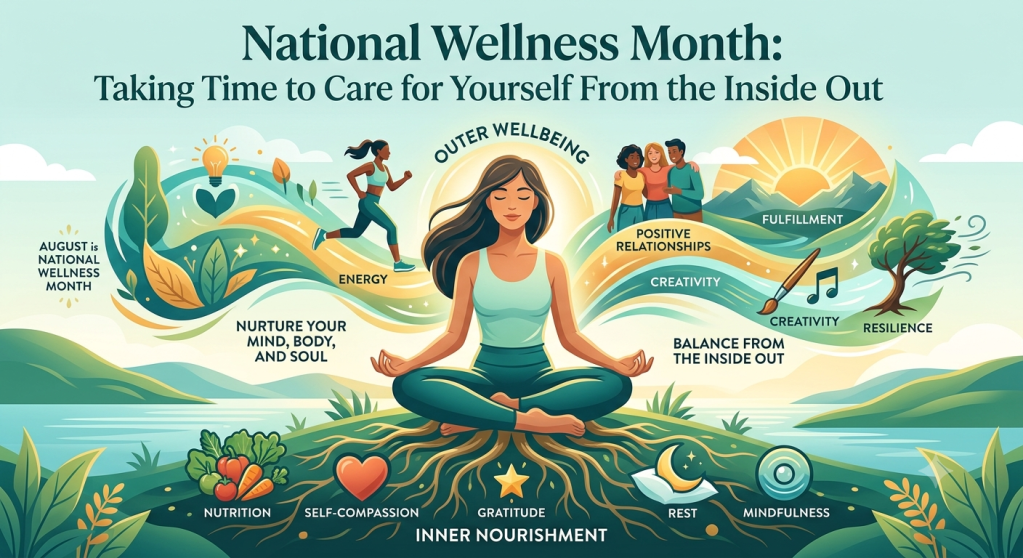
National Wellness Month: Taking Time to Care for Yourself From the Inside Out.

August is National Wellness Month, a wonderful opportunity to pause, reflect, and think about how we are really looking after ourselves.

With the pace of everyday life, it is easy to get caught up in work, responsibilities, and endless to-do lists. We often spend so much time caring for others that we forget to check in with ourselves. But our own wellbeing matters too.

Wellness is not just about being physically healthy. It is about how we feel, how we cope with challenges, how we connect with others, and how we create balance in our lives.

At Inside Out Wellbeing, we believe that true wellbeing starts from within. When we take care of our thoughts, emotions, and bodies, we create a stronger foundation for living a more balanced and fulfilling life.

What Does Wellness Mean to You?

Wellness means something different to everyone.

For some people, it may mean having more energy and taking better care of their physical health. For others, it may mean finding calm during stressful times, improving confidence, or learning to be kinder to themselves.

Wellness is not about changing everything overnight or trying to live a perfect life. It is about making small choices every day that help us feel better and more connected to ourselves.

Looking After Your Physical Wellbeing

Our bodies do so much for us every day, yet they are often the first thing we neglect when life gets busy.

Taking care of your physical wellbeing can be simple:

  • Going for a walk and enjoying some fresh air
  • Choosing nourishing foods that make you feel good
  • Drinking enough water
  • Getting better quality sleep
  • Giving yourself time to rest

Movement does not have to be about exercise goals or pushing yourself harder. Sometimes, it is simply about enjoying the feeling of moving your body and giving yourself some time away from daily pressures.

Caring for Your Mental Health

Our minds are constantly busy — thinking, planning, worrying, and processing everything happening around us. Taking care of our mental wellbeing helps us feel more grounded and able to handle life’s ups and downs.

Simple practices that can support your mental health include:

  • Taking a few quiet moments for yourself each day
  • Spending time outdoors
  • Writing down your thoughts
  • Practising mindfulness or deep breathing
  • Taking breaks from technology and social media

Even small moments of calm can make a difference.

Making Space for Your Emotions

Our emotions are a natural part of who we are. Some days feel easier than others, and that is completely normal.

Emotional wellbeing is about allowing ourselves to experience our feelings without judgement. It means recognising when we need support, setting healthy boundaries, and treating ourselves with the same kindness we would offer to someone we care about.

Sometimes, simply acknowledging how we feel can be the first step towards feeling better.

Small Changes Can Make a Big Difference

Wellness does not have to involve huge lifestyle changes. Often, the smallest actions have the greatest impact.

This August, why not choose one small thing to focus on?

It could be:

  • Taking a few minutes each morning to slow down
  • Spending more time doing something you enjoy
  • Connecting with a friend or loved one
  • Creating a healthier routine
  • Practising gratitude for the little things

Small steps, repeated consistently, can help create lasting positive changes.

Creating a Life That Supports Your Wellbeing

National Wellness Month is a reminder that self-care is not selfish. Looking after yourself allows you to show up more fully in every area of your life.

When we feel balanced and supported, we are better able to nurture our relationships, manage challenges, and enjoy the moments that matter.

Wellbeing is not about having a perfect life. It is about creating a life where you feel connected, supported, and able to be yourself.

Final Thoughts

This National Wellness Month, take some time to reconnect with yourself.

Listen to your body. Be mindful of your thoughts. Give yourself permission to rest. Celebrate the progress you have made and remember that your wellbeing deserves attention every day — not just in August.

Wellness begins from within, and every small step you take towards caring for yourself matters.

Welcome to Inside Out Wellbeing 

A New Chapter Rooted in Health, Nourishment & Inner Calm

If you’ve been part of my journey for a while, you’ll remember my blog Lena’s Kitchen Veggie Lena  a space filled with plant-based inspiration, wholesome recipes, and a love for nourishing food.

That chapter will always be special to me.

But as I’ve grown personally and professionally so has my vision. I’m so excited to officially welcome you to Inside Out Wellbeing.

Why the Rebrand?

Over the years, my work has expanded far beyond the kitchen.

As a qualified Nutrition Coach and Health & Wellness Coach, I’ve had the privilege of supporting people not just with what’s on their plate, but with how they feel in their bodies, how they manage stress, how they nourish their minds, and how they reconnect with themselves.

Food is powerful  but true wellbeing goes deeper.

I wanted a space that reflects the full picture:

🥦 Nourishing nutrition

🧠 Holistic health

🧘🏽‍♀️ Meditation & mindfulness

💚  lifestyle habits

Inside Out Wellbeing represents what I truly believe:

Real health starts from within.

When we support our inner world  our thoughts, stress levels, emotional health, gut health, nervous system  everything on the outside begins to shift.

What You Can Expect Here

This new space is about whole-person wellbeing.

You’ll still find nutrition guidance and realistic, nourishing food ideas. But you’ll also see more:

Practical wellness tools you can actually implement.

Mindset shifts for sustainable change.

Simple ways to reduce stress and feel calmer.

Meditation guidance

 (including my online course)

Honest conversations about balance 

This isn’t about extremes.

It isn’t about restriction.

It isn’t about chasing ideal health.

It’s about creating wellbeing that feels good, sustainable, and aligned with your real life.

Why “Inside Out”?

Because no amount of green smoothies can compensate for chronic stress.

No perfect meal plan replaces self-awareness.

No external routine creates lasting change without inner alignment.

When we:

regulate our nervous system

build supportive habits

nourish our bodies properly

create space to breathe

We transform from the inside out. That’s  the work I’m most passionate about now.

Thank You for Growing With Me

If you’ve been here since the Veggie Lena days — thank you.

If you’re new here — welcome.

Inside Out Wellbeing is more than a blog. It’s a space for grounded, realistic health. A space for women who want to feel energised, calm, strong, and connected  without overwhelm.

This rebrand isn’t about starting over. It’s about stepping fully into who I am now.

And I’m so glad you’re here for it.

With warmth,

Leena 

Embracing Inner Peace: World Meditation Day 2024

Hey there, mindful souls! As the world gears up to celebrate World Meditation Day on May 21st, 2024, it’s time to dive deep into the transformative power of meditation and its profound impact on our lives.

In a world brimming with chaos, stress, and endless distractions, the practice of meditation serves as a beacon of serenity, guiding us back to our innermost selves. Whether you’re a seasoned meditator or a curious beginner, this global event invites us all to take a collective pause and reconnect with the present moment.

Here’s why World Meditation Day is more than just another day on the calendar – it’s a movement towards inner peace, clarity, and holistic well-being.

 Global Pause for Peace:

In a world that often feels divided, World Meditation Day transcends boundaries and brings people together in the spirit of unity and harmony. As millions of individuals around the globe sit in silence, the collective energy of peace and positivity ripples across continents, fostering a sense of interconnectedness and oneness.

Stress Relief in Turbulent Times:

With the fast-paced nature of modern life, stress has become an all too familiar companion for many. However, meditation offers a sanctuary of calm amidst the storm. By simply closing our eyes and focusing on our breath, we can alleviate stress, reduce anxiety, and cultivate a profound sense of relaxation that extends far beyond the meditation cushion.

A Journey Inward:

Beyond its immediate benefits, meditation is a journey inward – a voyage of self-discovery and introspection. Through regular practice, we peel back the layers of conditioning and societal noise, revealing the essence of who we truly are. World Meditation Day encourages us to embark on this inner pilgrimage, exploring the depths of our consciousness and uncovering the limitless potential that resides within.

Empowering Mind, Body, and Spirit:

The benefits of meditation extend far beyond the confines of the mind. Research has shown that regular meditation practice can lead to improved focus, enhanced creativity, and even a stronger immune system. Moreover, it fosters a profound sense of connection with our bodies and nurtures our spiritual growth, allowing us to tap into a wellspring of inner wisdom and intuition.

Seeding Positive Change:

As we cultivate peace within ourselves, we become catalysts for positive change in the world around us. World Meditation Day serves as a reminder that our individual actions ripple outward, influencing the collective consciousness and shaping the reality we inhabit. By fostering inner peace and compassion, we contribute to a more harmonious and compassionate world for future generations.

How Meditation Enhanced My Mind and Body

Meditation has been a transformative practice for both my mental and physical well-being. Through regular meditation sessions, I’ve experienced profound shifts in my overall mindset and outlook on life. Mentally, meditation has provided me with a sense of clarity and calmness amidst life’s inevitable chaos. It has become a sanctuary where I can observe my thoughts without judgment, fostering a greater sense of self-awareness and emotional resilience. Physically, the benefits have been equally remarkable. I’ve noticed a significant reduction in stress levels, leading to improvements in sleep quality and a heightened sense of energy throughout the day. Moreover, the practice has helped alleviate chronic pain and tension in my body, promoting relaxation and a greater sense of vitality. Overall, meditation has become an essential tool in my holistic approach to health, enriching both my mind and body in profound ways.

So, as May 21st approaches, let’s join hands – or rather, hearts – and embark on this transformative journey together. Whether you choose to meditate solo, join a group session, or participate in virtual events, let’s unite in the spirit of mindfulness and spread the ripple of peace far and wide.

Remember, the power to transform our world lies within each and every one of us. Let’s harness the transformative power of meditation and pave the way for a brighter, more peaceful future.

Happy World Meditation Day, fellow seekers of serenity. May your journey inward be as boundless as the universe itself.

Namaste 🙏.

3-3-3 Rule: Practical Technique for Anxiety Relief

Do you ever find yourself trapped in a whirlwind of anxious thoughts, unable to break free from the cycle of worry and stress? In the fast-paced world we live in, anxiety has become an all too common companion for many of us. But what if I told you there’s a simple yet powerful technique that could help you find calm amidst the chaos? Enter the 3-3-3 rule – a game-changing strategy for managing anxiety and reclaiming your peace of mind.

What is the 3-3-3 Rule?

The 3-3-3 rule is a straightforward method designed to ground you in the present moment and alleviate feelings of anxiety. It consists of three steps, each involving the senses, to bring you back to a state of equilibrium:

Name Three Things You See: 

Start by observing your surroundings and identifying three things you can see. It could be anything from the texture of the walls to the colour of the sky. By focusing on the present moment, you shift your attention away from anxious thoughts and anchor yourself in reality.

Acknowledge Three Sounds You Hear: 

Tune in to the sounds around you and identify three distinct noises. It might be the hum of traffic outside your window or the gentle rustling of leaves in the wind. Listening attentively to the present soundscape helps quieten the noise in your mind and promote a sense of calm.

Move Three Parts of Your Body: 

Engage your body by moving three different parts – perhaps wiggle your toes, roll your shoulders, or stretch your arms. Physical movement not only releases tension but also redirects your focus away from anxious feelings and towards the sensations of your body in motion.

Why Does It Work?

The brilliance of the 3-3-3 rule lies in its simplicity and effectiveness. By engaging multiple senses and incorporating physical movement, it interrupts the cycle of anxious rumination and brings your awareness back to the present moment. This mindfulness practice is rooted in the principles of grounding techniques, which aim to anchor you in the here and now, away from the spiralling thoughts of the past or future.

How to Incorporate the 3-3-3 Rule into Your Life

The beauty of the 3-3-3 rule is its versatility – you can use it anytime, anywhere, whenever you feel overwhelmed by anxiety. Whether you’re at work, in the grocery store, or lying in bed at night, this technique is always at your disposal. With regular practice, it becomes a valuable tool in your mental health toolkit, helping you navigate life’s challenges with greater ease and resilience.

Join the Movement

The 3-3-3 rule is more than just a coping strategy – it’s a mindset shift towards greater self-awareness and emotional well-being. As more people discover its transformative power, the 3-3-3 rule is quickly gaining traction as a viral trend in the realm of mental health and self-care. Join the movement today and take the first step towards a calmer, more grounded existence.

The 3-3-3 rule offers a simple yet profound antidote to anxiety, inviting you to reconnect with the present moment and reclaim control over your mental state. So the next time you feel overwhelmed by worry or stress, remember the power of three – see, hear, move – and watch as your anxiety melts away, leaving behind a newfound sense of peace and clarity.

Incorporating the 3-3-3 rule into your daily routine can be a transformative practice for cultivating inner peace amidst the chaos of everyday life. Imagine starting your day with three minutes of deep breathing exercises, allowing yourself to centre and ground before diving into the demands of the day. Throughout the day, take three brief breaks to check in with yourself, perhaps through a quick mindfulness exercise or a simple stretch to release tension. Finally, before bed, dedicate another three minutes to reflection, journaling, or gratitude practice, easing your mind and preparing for restorative sleep. By consistently integrating these small yet impactful moments into your routine, you can gradually rewire your brain to respond to stress with calmness and resilience. Remember, it’s the consistency and commitment to these practices that truly unlock their transformative power in promoting mental well-being.