Transforming Movement: More Than Just Exercise

When we think about exercise, we often think about getting fitter, losing weight, building strength or looking after our physical health.

But movement can offer us so much more than that.

What if going for a walk wasn’t just about getting your steps in, but about clearing your head after a difficult day?

What if ten minutes of stretching wasn’t “not enough”, but exactly what your body needed?

And what if movement wasn’t something you had to force yourself to do because you ate too much or missed a workout?

For me, movement is about much more than exercise. its about how it makes me feel.

When You’re Stressed, Your Body Feels It Too

Have you ever had one of those days where your mind just won’t switch off?

Your thoughts are racing, your shoulders feel tense, you’re tired but wired, and even when you finally sit down, you don’t feel relaxed.

Stress doesn’t just affect our minds. We can feel it physically too.

This is one reason movement can be so helpful.

Something as simple as going for a walk can give you the chance to step away from whatever has been overwhelming you. You change your surroundings, get some fresh air and give your mind something else to focus on.

You don’t need to run five miles or complete an intense workout.

Sometimes, a gentle walk around the block is enough to change how you feel.

And I think we often forget just how powerful those simple things can be.

You Don’t Have to Exercise to Exhaustion

There can be so much pressure around exercise.

We’re constantly told to push harder, burn more calories, get more steps and work towards the next goal.

But more isn’t always better.

If you’re already exhausted, stressed and running on empty, another punishing workout might not be what you need.

Maybe you need to slow down.

Maybe you need some gentle yoga.

Maybe you need to walk in the sunshine.

Maybe you need to dance around the kitchen while making dinner.

Movement doesn’t have to look a certain way to count.

It doesn’t matter whether you’ve been to an expensive gym or walked around your local park. Moving your body can still be a positive act of self-care.

Movement Can Help You Feel More Grounded

There is a reason you can sometimes return from a walk feeling completely different from when you left.

Physical activity can support our mood and help us manage stress. But there’s something else about movement that I particularly love.

It can help us get out of our heads and back into our bodies.

We’re often thinking about yesterday, worrying about tomorrow and trying to keep up with everything that needs doing.

Movement can bring us back to the present moment.

When you’re walking, you might notice the trees, the weather, the sounds around you, your breathing or simply the feeling of your feet touching the ground.

You don’t have to turn it into a mindfulness exercise.

Just being outside and paying attention to what’s around you can be surprisingly grounding.

What If You Don’t Feel Motivated?

This is something I hear all the time:

“I know I should exercise, but I just can’t motivate myself.”

And honestly, I don’t think you always need motivation.

Sometimes you just need to make the first step really small.

Don’t tell yourself you’re going to complete a one-hour workout.

Tell yourself you’re going to put your trainers on and walk for ten minutes.

If you want to carry on, great.

If you don’t, that’s okay too.

Ten minutes still counts.

And sometimes, once you’ve started moving, you’ll naturally feel like doing a little more.

The hardest part can simply be getting started.

Movement Can Support Better Sleep

Sleep, stress, movement and our overall wellbeing are closely connected.

When we’re stressed, sleep can suffer. When we don’t sleep well, we can feel tired and unmotivated. And when we’re exhausted, exercise can be the last thing we want to do.

It can become a cycle.

Regular movement can be one piece of the puzzle, helping us stay active during the day and supporting healthier sleep habits.

Again, it doesn’t need to be extreme.

A walk after dinner.

A few gentle stretches.

A little movement during the day when you’ve been sitting for too long.

The aim isn’t to create another thing on your “must do” list.

It’s about finding small things that support you.

Let’s Stop Thinking About Exercise as Punishment

This is something I’m particularly passionate about.

Exercise shouldn’t be a punishment for eating a piece of cake.

You don’t need to “burn off” your dinner.

You don’t have to earn your food.

Food and movement don’t need to be tools for guilt or punishment.

Your body needs food for energy and nourishment. It also benefits from movement for strength, mobility, fitness and overall health.

These things can work together beautifully when we take guilt out of the equation.

Instead of thinking:

“I need to exercise because I ate too much.”

Try:

“I’m going to move because I want to look after my body.”

That small change in language can completely change how we think about exercise.

Find Something You Actually Enjoy

If you hate running, you don’t have to run. There are so many ways to move your body that you will enjoy:

  • Walking
  • Swimming
  • Cycling
  • Dancing
  • Gardening
  • Pilates
  • Yoga
  • Strength training
  • Tennis
  • Hiking
  • Fitness classes

Or simply put your favourite music on and dance around the house.

There is no single “best” form of exercise.

The best movement for you is something that fits into your life and that you’re actually going to want to do.

There’s no point following someone else’s perfect workout routine if you dread every minute of it.

Find what works for you.

Don’t Underestimate Walking

Walking is one of the simplest ways to add more movement to your day.

You don’t need special equipment.

You don’t have to be particularly fit.

You can do it alone, with a friend, with the family or even while listening to a podcast.

Or you can leave your headphones at home and simply enjoy some quiet.

One of my favourite things about walking is the space it creates.

Space to think.

Space to breathe.

Space to listen.

Or space to have absolutely nothing playing in your ears.

Just you, your thoughts and the world around you.

If you’re having a difficult day, try going outside for ten minutes before deciding that the day is a write-off.

You might be surprised by how much better you feel afterwards.

Movement and Nutrition Go Hand in Hand

As a nutrition and wellness coach, I also think it’s important to talk about food when we’re talking about movement.

Your body needs fuel.

If you’re constantly restricting food, skipping meals or trying to exercise as much as possible while eating as little as possible, you’re not necessarily supporting your wellbeing.

You need energy to move, nutrients to support your body and enough food to recover.

Eating well isn’t about being perfect.

It’s about giving your body what it needs most of the time.

Think about nourishing meals with plenty of variety — protein, whole grains, fruit and vegetables, healthy fats and plenty of fluids.

And please remember:

You don’t need to earn your food.

You are allowed to eat because you’re hungry.

You are allowed to enjoy food.

And you are allowed to move your body because it feels good.

So, How Much Movement Do You Really Need?

There isn’t one perfect amount of movement that works for everyone.

Your starting point matters.

Your health matters.

Your lifestyle matters.

And what feels realistic for you matters.

If you’re currently doing very little, you don’t need to suddenly decide you’re going to exercise for an hour every day.

Start somewhere manageable.

Ten minutes.

A short walk.

A few stretches.

Taking the stairs.

Getting up from your desk regularly.

Walking while you’re on the phone.

Those small moments of movement add up.

And once they become part of your routine, you can build from there if you want to.

Think About How You Want to Feel

Rather than focusing only on what exercise might change about your body, I’d encourage you to think about how you want to feel.

Do you want more energy?

To feel stronger?

To sleep better?

To feel less stressed?

To clear your head?

To feel more comfortable and confident in your body?

To spend more time outside?

Your answer might help you decide what type of movement feels right for you.

Because wellbeing isn’t just about how we look.

It’s about how we live and feel in our bodies every day.

Start Small

If movement hasn’t been part of your routine for a while, please don’t feel that you need to completely overhaul your life.

Start small.

Put your shoes on.

Go outside.

Walk around the block.

Stretch for five minutes.

Put some music on.

Do something that makes you feel good.

And tomorrow, come back to it again.

You don’t need to be perfect.

You just need to keep finding ways to look after yourself.

A Little Reminder From Me

I think sometimes we make looking after ourselves far more complicated than it needs to be.

We don’t always need another challenge, another diet or another intense workout programme.

Sometimes we need to eat a nourishing meal, get outside, move our bodies, have a good night’s sleep and give ourselves a little breathing space.

That’s what wellbeing means to me.

It’s not about doing everything perfectly.

It’s about making small choices, regularly, that help you feel more like you.

So next time you’re feeling stressed, tired or stuck in your head, try moving your body.

Not because you have to.

Not because you need to burn calories.

But simply because you deserve to feel good.

From the inside out. 🌿


I’d love to hear from you…

What’s your favourite way to move your body when you need a little lift?

Is it a walk, yoga, swimming, dancing, the gym — or something completely different?

I’d love to know.

Nourishing Breakfasts That Take Less Than 5 Minutes (and Support Your Mood All Day)

Let’s talk about breakfast. Not in a complicated, track-your-macros way. In a simple, nourish-your-nervous-system, feel-good-all-morning way.

what you eat within the first 90 minutes of waking up sets your blood sugar — and your mood — for the entire day.

Here are three of my favourite quick, nourishing breakfasts that I genuinely make and eat myself.

1. Greek Yoghurt with Berries and Seeds

Spoon full-fat Greek yoghurt into a bowl. Add a handful of frozen berries (they defrost in minutes), a tablespoon of pumpkin seeds, and a drizzle of honey.

Why it works: The protein in the yoghurt stabilises your blood sugar. The berries are full of antioxidants that support your mood and reduce inflammation. The pumpkin seeds are one of the richest sources of magnesium the mineral most of us are deficient in and the one most linked to anxiety and poor sleep.

This breakfast takes three minutes and it genuinely changes how you feel by 11am.

2. Oats with Nut Butter and Banana

Make your porridge however you like it. Stir in a tablespoon of almond or peanut butter while it’s still warm. Slice half a banana on top.

Why it works: Oats are a slow-release carbohydrate, meaning they release energy steadily rather than spiking and crashing your blood sugar. The nut butter adds healthy fat and protein to keep you full and focused. And bananas contain tryptophan — a precursor to serotonin, your feel-good hormone.

Warm, comforting, and genuinely good for your brain chemistry.

3. Eggs on Rye Toast with Avocado

Toast one slice of rye bread. Slice a quarter of an avocado. Done.

Why it works: Avocado provides healthy monounsaturated fats that support hormone production. Rye bread is lower on the glycaemic index than white bread, so it won’t spike your blood sugar.

This is the breakfast I eat when I want to feel sharp, calm, and completely nourished.

None of these breakfasts require meal prep, complicated ingredients, or more than five minutes of your morning. They just require the decision to nourish yourself first before the emails, before the chaos, before everything else.

You are worth five minutes,

Which one are you trying this weekend? Let me know in the comments.


With warmth,
Leena 🌿

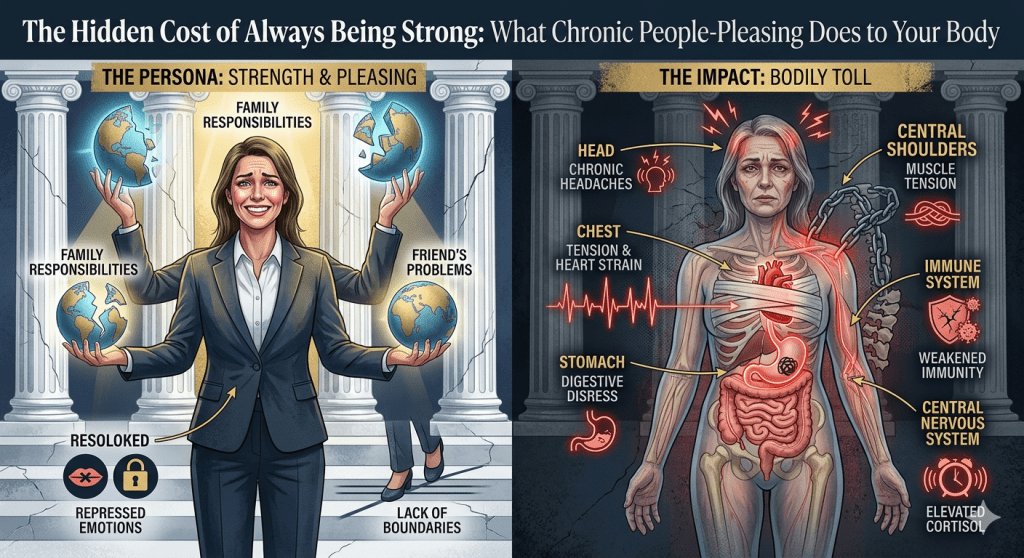
The Hidden Cost of Always Being Strong: What Chronic People-Pleasing Does to Your Body

There is a particular kind of exhaustion that comes from

always being the strong one.

The one who holds everything together. The one who says yes when she means no. The one who manages everyone else’s feelings before she even checks in with her own.

If you recognise yourself in those words this post is for you.

People-pleasing isn’t a personality trait. It’s a nervous system response.

Most of us learn to people-please very early in life. We discover that keeping others happy keeps us safe from conflict, from disapproval, from being seen as difficult or too much. Over time, this becomes automatic. We stop asking ourselves what we want and need. We simply respond to what others seem to require of us.

What we don’t realise is that this constant monitoring this hypervigilance to other people’s moods and needs is exhausting the nervous system on a profound level.

Your nervous system cannot distinguish between physical danger and social threat. Disapproval, conflict, and disappointing others all register as danger signals. And your body responds accordingly raising cortisol, tightening your muscles, heightening your alertness. Every single time.

When this happens repeatedly across an entire lifetime, the body starts to pay a price.


What chronic people-pleasing does to your body


It keeps cortisol chronically elevated.

Cortisol is your primary stress hormone. In short bursts it’s helpful. But when it’s elevated day after day because you’re constantly anticipating other people’s reactions, managing their feelings, bracing for conflict it begins to suppress your immune system, disrupt your sleep, and contribute to that bone-deep exhaustion that no amount of rest seems to fix.

It disconnects you from your own hunger and needs


When you spend your life attending to what everyone else wants, you stop noticing what you want. Many chronic people-pleasers struggle to identify their own hunger, their own preferences, their own emotions. The body’s signals become quiet and eventually, you stop hearing them altogether.


It creates chronic muscle tension

Always being on always performing okayness, always managing the atmosphere in a room requires the body to be in a constant state of readiness. The jaw clenches. The shoulders rise. The stomach tightens. Over time, this tension becomes the baseline. You forget what it feels like to be truly at ease in your own body.


It depletes your energy at a cellular level


Emotional labour the constant work of managing relationships, smoothing things over, anticipating needs is genuinely physically tiring. It consumes glucose, elevates cortisol, and taxes the same physiological systems as physical exertion. The tiredness you feel is real. It is not weakness. It is the cost of years of invisible work.


What begins to help


The path out of chronic people-pleasing is not about suddenly becoming selfish or cold. It’s about learning to include yourself in the circle of people whose needs matter.

It begins with noticing. Noticing when you say yes and mean no. Noticing the tightening in your chest when someone asks something of you that you don’t want to give. Noticing the relief you feel even briefly when you allow yourself to choose yourself.

It continues with practice. Saying no to one small thing. Pausing before you automatically agree. Asking yourself before you respond to anyone else what do I actually need right now?


It deepens with support. Because unlearning a lifetime of conditioning is not something you should have to do alone.

You are allowed to have needs, Leena 🌿
You are allowed to be tired.


You are allowed to take up space.


💬 Does this resonate with you? I’d love to hear your thoughts in the comments below. And if this post spoke to you, please share it with a woman in your life who needs to hear it today.


With warmth,
Leena 🌿

Subscribe at the bottom of the page for weekly posts on nervous system health, nutrition, and holistic wellbeing.

The 10-Minute Wind-Down Routine That Will Change How You Sleep

If you’re lying awake at night with your mind racing running through tomorrow’s to-do list, replaying conversations, wondering why you can’t just switch off this post is for you.

The problem isn’t that you can’t sleep. The problem is that you haven’t given your nervous system permission to stop.


Here’s a 10-minute wind-down routine that genuinely works. Not because it’s complicated. Because it’s consistent.

Minutes 1–2: Put your phone in another room not on silent. Not face down. Another room. The mere presence of your phone on your bedside table keeps your brain on low-level alert waiting, watching, ready to respond. Remove it completely and notice how the room feels different.


Minutes 3–4: Make a warm drink
Chamomile tea, warm oat milk, or simply warm water with honey. The act of making something warm and holding it in your hands is a signal to your nervous system that the day is over. You are safe. You can slow down now.


Minutes 5–7: Write a brain dump
Take a piece of paper and write down everything that’s in your head. Worries, tomorrow’s tasks, random thoughts all of it. Get it out of your mind and onto the page. Your brain holds onto unfinished thoughts to make sure you don’t forget them. Once they’re written down, it can finally let go.


Minutes 8–10: Legs up the wall
Lie on your back and rest your legs up against the wall. This gentle inversion calms the nervous system, reduces cortisol, and signals to your body that it’s time to rest. Even five minutes in this position can dramatically reduce the time it takes you to fall asleep.

That’s it. Ten minutes. The same ten minutes every night.

Consistency is what makes this work. Your nervous system loves routine. When you do the same calming sequence every evening, your body begins to anticipate sleep — and falling asleep becomes easier and easier over time.
You deserve rest, Leena 🌿


Which part of your evening routine do you find hardest to wind down from?

Tell me in the comments.

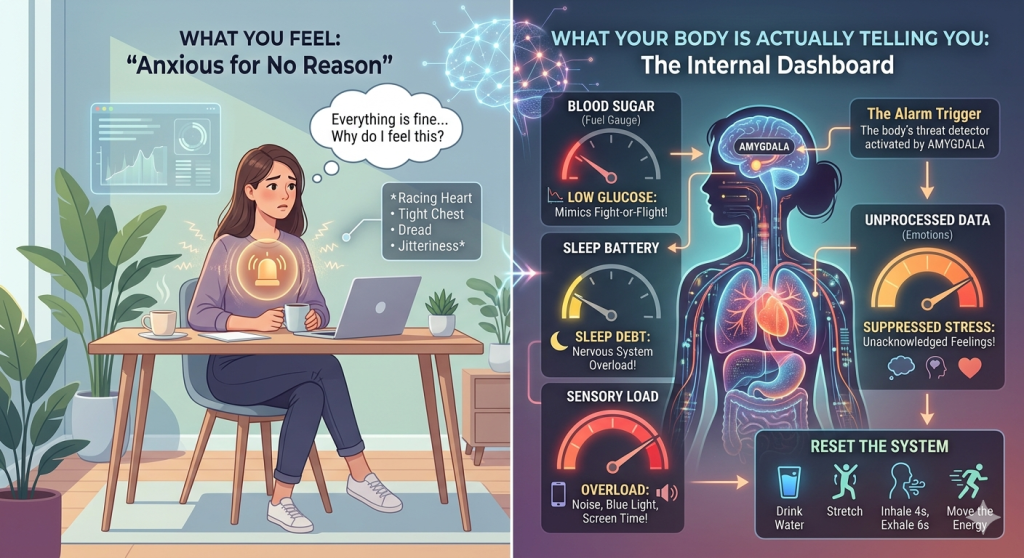
Why You Feel Anxious for No Reason — and What Your Body Is Actually Trying to Tell You

Have you ever woken up with that low-level feeling of dread, a tightness in your chest, a flutter of anxiety and had absolutely no idea why?

No big event coming up. Nothing obviously wrong. Just that quiet, constant hum of unease that follows you through the day.

You’re not imagining it. And you’re not broken. But what’s happening inside your body might surprise you.
Anxiety isn’t always in your mind

We tend to think of anxiety as a psychological problem, something to do with our thoughts, our worries, our mindset. And sometimes it is. But very often, what we experience as anxiety is actually a physiological response happening in the body completely independent of what we’re consciously thinking about.

Your nervous system is constantly scanning for danger. It doesn’t distinguish between a physical threat and an emotional one. A difficult conversation, a long to-do list, a blood sugar crash, chronic inflammation, poor sleep, too much caffeine all of these register as stress signals in your body. And your body responds the same way it always has: by releasing cortisol and adrenaline, raising your heart rate, and putting you on high alert.

That feeling? That is anxiety. And it started in your body, not your mind.

4 physical reasons you might feel anxious for no reason

1. Your blood sugar is unstable

This is one of the most underestimated causes of anxiety. When your blood sugar drops from skipping meals, eating refined carbs alone, or relying on caffeine our body releases cortisol to compensate. Cortisol raises your blood sugar again, but it also creates that familiar feeling of jitteriness, racing thoughts, and a sense that something is wrong.

If your anxiety tends to peak mid-morning or mid-afternoon, blood sugar instability could be the root cause.

2. Your nervous system is in chronic overdrive

Your nervous system has two settings: sympathetic (fight or flight) and parasympathetic (rest and digest). Most of us are living permanently in sympathetic mode checking phones first thing in the morning, never fully switching off, moving from one demand to the next without space to breathe.

When your nervous system never gets to rest, it starts to misfire. It registers ordinary situations as threats. And the result is that constant background anxiety that you can’t quite explain.

3. You’re not getting enough magnesium

Magnesium plays a crucial role in regulating the nervous system. It supports the production of GABA, the neurotransmitter that calms the brain down. When magnesium levels are low, the nervous system becomes hypersensitive and anxiety increases.

Most women are deficient in magnesium, particularly those under chronic stress, because stress depletes magnesium rapidly. Dark leafy greens, pumpkin seeds, dark chocolate, and almonds are among the richest dietary sources.

4. You’re not processing your emotions

Unfelt emotions don’t disappear. They settle in the body as tension, tightness, and that low-level unease we so often mistake for anxiety. Women who carry a lot who manage everyone else’s needs, who suppress their own feelings to keep the peace, who never quite allow themselves to fall apart 0ften experience this kind of body-held anxiety most acutely.

The body keeps score. And eventually, it asks to be heard.

What actually helps

Eat regular meals with protein and fibre to keep your blood sugar stable. Build moments of genuine stillness into your day not scrolling, not multitasking, just breathing. Add magnesium-rich foods to your diet daily. And find safe spaces to feel what you feel — whether that’s journalling, therapy, a trusted friend, or coaching.

Anxiety is not a character flaw. It is your body communicating with you. And when you learn to listen and respond with nourishment rather than resistance everything begins to shift.

You are not too sensitive. You are not overreacting. You are a human being whose body is asking for support.

💬 Does any of this resonate with you? Which of the four causes feels most familiar? 

Drop a comment below, I read and reply to every single one.

With warmth,
Leena 🌿

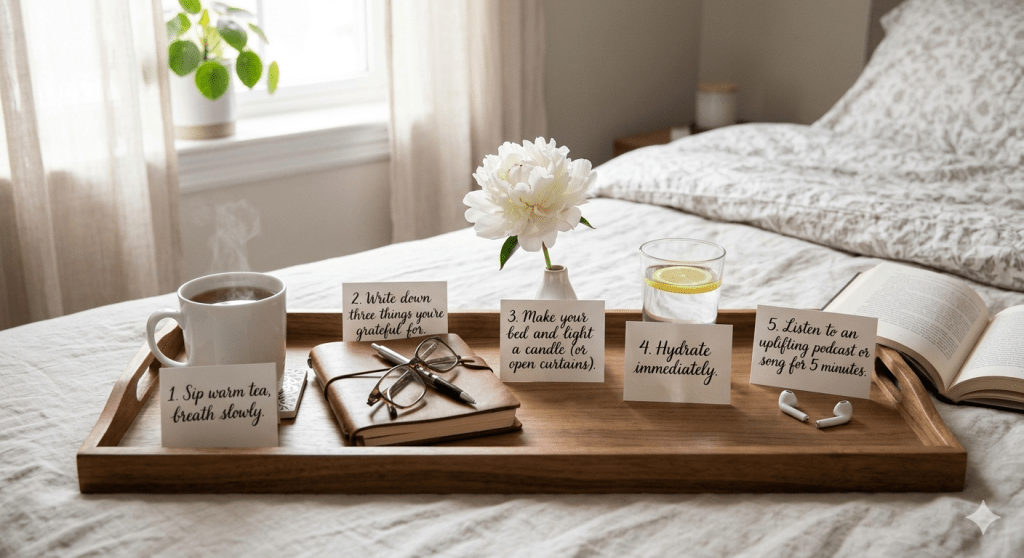
5 Small Things You Can Do This Morning to Feel Better Today

You don’t need a complete lifestyle overhaul to start feeling better. Sometimes the smallest shifts make the biggest difference especially when your nervous system is running on empty.

Here are five gentle things you can do this morning, right now, wherever you are.

Drink a glass of water before anything else. Before the coffee, before the phone, before the to-do list. Just water. Your body has been fasting all night and hydration is one of the simplest ways to support your energy and your mood from the very first moment of your day.

Take five slow breaths

Inhale for four counts and exhale for seven. Do this five times before you get out of bed. This simple breathing pattern activates your parasympathetic nervous system, your body’s rest and digest mode and sets a calmer tone for your entire morning.

Eat something within 90 minutes of waking; I know, I know you might not feel hungry. Skipping breakfast sends your blood sugar crashing, which triggers a cortisol spike, which feels a lot like anxiety. A handful of nuts, some Greek yoghurt, or a piece of fruit with nut butter is all you need to stabilise your energy and your mood.

Step outside for ten minutes  without your phone. Just you and some fresh air and a patch of sky. Nature genuinely lowers cortisol levels. It isn’t a luxury,  it’s medicine.

Write down one thing you’re not going to worry about today

Not a gratitude list or a to-do list. Just one thing you are consciously choosing to set down for today. One thing that can wait. Give yourself that gift.

These five things take less than thirty minutes combined. And yet they speak directly to your nervous system, your blood sugar, and your emotional wellbeing.  The three things that most determine how you feel on any given day. You don’t have to do all five. Start with one. See how it feels.

With warmth,

Leena 🌿

Which of these feels most doable for you this morning? 

Drop a comment below, I read and reply to every single one.

The Gut-Mental Health Connection: Why Your Stomach Holds the Key to Your Mood

Have you ever had a gut feeling about something? 

Felt butterflies before a big moment? Noticed your stomach tighten when you’re anxious, or felt nauseous when you’re scared?

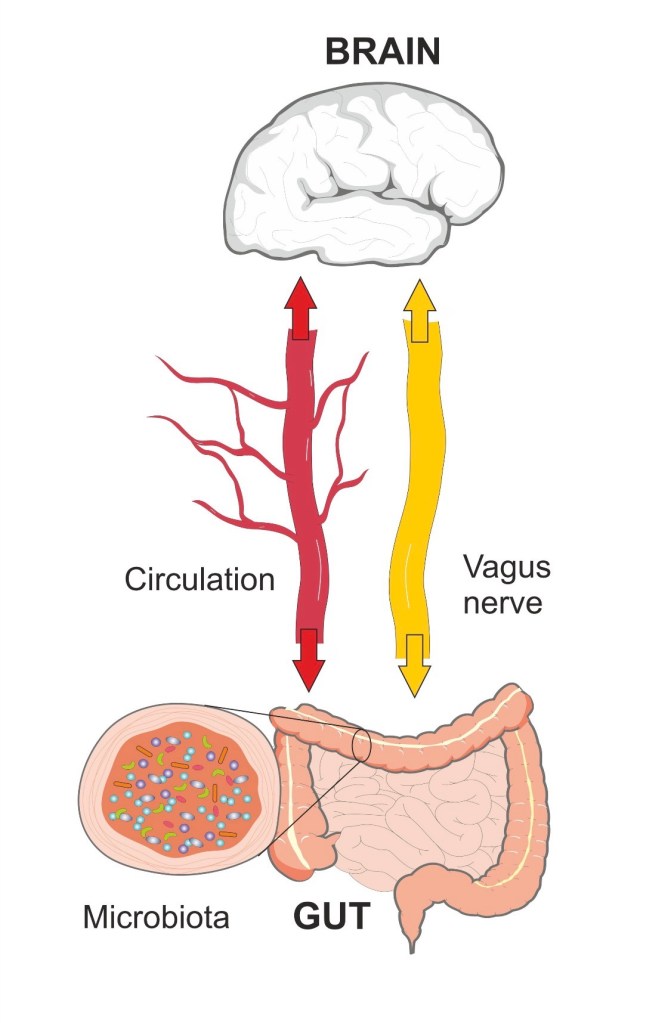
That is not a coincidence. That is your gut and your brain in constant, real-time conversation and what’s happening in your digestive system has a profound effect on your mental health, your mood, and your ability to cope with stress.

Have you ever had a gut feeling about something? 

Felt butterflies before a big moment? Noticed your stomach tighten when you’re anxious, or felt nauseous when you’re scared?

That is not a coincidence. That is your gut and your brain in constant, real-time conversation and what’s happening in your digestive system has a profound effect on your mental health, your mood, and your ability to cope with stress.

This is one of the most exciting areas of nutrition science right now, and it could completely change how you think about your mental wellbeing.

Meet Your Second Brain

Your gut contains over 500 million neuron’s more than your spinal cord. Scientists now call it the “enteric nervous system” or your second brain, and it operates largely independently of the brain in your head.

But here’s the part that surprises most people: approximately 90% of your serotonin  your primary feel good neurotransmitter  is produced in your gut and not your brain.

This means that the health of your digestive system directly impacts your mood, your anxiety levels, your sleep, and your emotional resilience.

What Damages Your Gut-Mental Health Connection

Chronic stress: cortisol disrupts your gut microbiome, reducing the diversity of beneficial bacteria.

Ultra-processed foods:  sugar, artificial sweeteners, and refined carbs feed harmful bacteria and reduce serotonin production

Antibiotics  while sometimes necessary, they wipe out both harmful and beneficial gut bacteria

Not enough fibre: Your  beneficial gut bacteria feeds on fibre., without it, they would starve.

Eating too fast: your gut needs a calm, parasympathetic state to digest properly. Eating on the go or under stress impairs digestion significantly.

5 Ways to Nourish Your Gut for Better Mental Health.

Eat fermented foods daily; Yogurt, kefir, sauerkraut, kimchi, and miso are all rich in beneficial probiotics that support a healthy microbiome and better mood regulation.

Increase your fibre intake; Aim for a wide variety of plant foods  vegetables, fruits, legumes, wholegrains, nuts and seeds. Each different plant feeds a different strain of beneficial bacteria.

Reduce ultra-processed foods

This doesn’t mean perfection. It means gradually crowding out the processed foods with more whole, nourishing alternatives.

Eat slowly and mindfully

Chew your food properly. Sit down to eat. Take three deep breaths before your meal to shift your nervous system into rest and digest mode. Your gut absorbs nutrients far more effectively in a calm state.

Manage your stress

Since stress directly damages your gut microbiome, nervous system regulation isn’t just good for your mind  it’s essential for your gut health too.

The Beautiful Truth

You cannot separate mental health from physical health. They are the same conversation, happening in the same body.

When you nourish your gut, you nourish your mind. When you calm your nervous system, you improve your digestion. When you eat well, you feel better emotionally. Everything is connected  and that is genuinely good news, because it means every small positive choice you make ripples through your entire wellbeing.

💬 I’d Love to Hear From You

Did you know that 90% of serotonin is made in the gut? Does that change how you think about what you eat?

Leave a comment below 

 I’d love to know your thoughts. And if this post opened your eyes to the gut-brain connection, share it with someone who might need to hear it.

Hit subscribe at the bottom of the page to get every new post straight to your inbox.

With warmth,

Leena 🌿

Nutrition & Wellness Coach | Inside Out Wellbeing

Are You Mentally Exhausted? 7 Gentle Ways to Feel Like Yourself Again

Let me ask you something.

When was the last time you felt truly, genuinely okay?

Not just “getting through the day” okay. Not “I’ll rest at the weekend” okay. But actually calm, present, and like yourself?

If you had to think about it for a while  this post is for you.

Mental exhaustion is one of the most common things I hear about from women I speak to. And yet it’s one of the least talked about. We normalise the tiredness. We push through the anxiety. We tell ourselves everyone feels this way.

But they don’t have to and  neither do you.

Here are seven gentle, realistic ways to start feeling like yourself again — no dramatic life overhaul required.

Stop Calling It “Just Stress”

The first step to feeling better is taking your mental exhaustion seriously.

Stress is not just a feeling. It is a full-body physiological response that affects your hormones, your immune system, your digestion, and your sleep. When we dismiss it as “just stress” we stop ourselves from getting the support we actually need.

Give yourself permission to say: *“I am not okay right now, and that matters.”

That one shift changes. everything.

Breathe Before You Reach for Your Phone

Most of us wake up and immediately check our phones  flooding our nervous system with news, notifications, and other people’s lives before we’ve even had a glass of water.

Tomorrow morning, try this instead: before you pick up your phone, take five slow deep breaths. Inhale for 4 counts, exhale for 7. It takes 60 seconds and it sets your entire nervous system up for a calmer day.

Small habit. Big difference.

Eat Something Before 10am

When we’re mentally exhausted, eating is often the first thing to go. We skip breakfast, grab coffee on the run, and wonder why we feel anxious and foggy by mid-morning.

Low blood sugar triggers a cortisol spike  which feels identical to anxiety. Something as simple as eating a protein-rich breakfast before 10am can noticeably reduce anxiety levels throughout the day.

Try Greek yogurt, or even a handful of nuts. Your brain will thank you.

Say No to One Thing This Week

Mental exhaustion often comes from a life that has too much in it and not enough rest between.

You do not need to justify saying no. You do not need a reason good enough for other people. “I don’t have the capacity right now” is a complete sentence.

Pick one thing on your list this week that you can cancel, delegate, or simply let go of. Notice how it feels.

Go Outside for 10 Minutes  Without Your Phone

Nature is not a luxury. It is a genuine, research-backed tool for mental health. Even 10 minutes outside  without scrolling  lowers cortisol, reduces anxiety, and improves mood.

You don’t need a park or a forest. A garden, a street, a patch of sky. Just step outside, leave your phone behind, and let your nervous system breathe.

Talk to Someone  Anyone

One of the cruelest things about mental exhaustion is that it makes us want to isolate at exactly the moment we need connection most.

You don’t need to have a deep conversation. You don’t need to explain everything. Simply being in the presence of someone who makes you feel safe  a friend, a family member, a coach  is enough to regulate your nervous system and remind you that you are not alone.

If you don’t feel you have that person right now, I want you to know: that is more common than you think, and it is something that can change.

Give Yourself One Moment of Joy Today  On Purpose

When we are burnt out we stop doing the things that light us up. We tell ourselves we’ll do them when we have more time, more energy, more of everything.

But joy is not a reward for getting through the hard stuff. It is part of what gets you through.

Today, on purpose, do one small thing that makes you feel like you again. A walk. A favourite meal. A song you love. A chapter of a book. Ten minutes of nothing at all.

You are allowed to feel good. Even now. Especially now.

 You Are Not Too Far Gone

Whatever you are carrying right now  however long you have been running on empty I want you to know that it is possible to feel better. Not perfectly. Not all at once. But genuinely, sustainably better.

Your nervous system wants to heal. Your body wants to rest. You just need to give it permission.

 💬 I’d Love to Hear From You

Which of these seven things do you need most right now?**

Drop a comment below and let me know — I read and reply to every single one. And if this resonated with you, please share it with someone who needs to hear it today. You never know whose week you might change. 

If you’d like to read more about stress, nutrition, and nervous system health, hit subscribe at the bottom of the page to get every new post straight to your inbox.

With warmth,

Leena 🌿

Fuelling the Calm: How Protein and Fiber Stabilise Your Mood

Have you ever noticed how a sugary breakfast leaves you feeling “on edge” by 11:00 AM? Or how skipping lunch makes you feel irritable, anxious, and unable to focus?

In the world of Inside Out Wellbeing, we often talk about meditation and mindset to find peace. Today, I want to talk about the physical foundation of your zen: Blood Sugar Stability.

The Rollercoaster of Mood

When we eat refined sugars or simple carbs alone, our blood sugar spikes and then crashes. This crash triggers a stress response in the body, releasing cortisol and adrenaline. Physically, this feels like anxiety. Mentally, it feels like burnout.

To find your calm, you need two secret weapons: Protein and Fiber.

1. Protein: The Building Block of “Happy” Hormones

Protein isn’t just for muscles. It provides the amino acids (like tryptophan) that your brain needs to produce Serotonin your feel-good hormone.

• The Inside Out Tip: Aim for a palm-sized portion of protein with every meal to keep your brain chemistry balanced.

2. Fiber: The Slow-Release Valve

Think of fiber as the brake for your digestion. It slows down the absorption of sugar into your bloodstream, preventing those spikes and crashes that leave you feeling shaky or moody.

The Inside Out Tip: Add a handful of leafy greens or chia seeds to your plate to “anchor” your energy.

The Calm Plate Formula

Next time you sit down to eat, ask yourself: Where is my protein? Where is my fiber? When you feed your body stability, your mind follows suit. You aren’t just eating for fuel; you are eating for peace.

🧘🏽‍♀️ Mindful Minute Reset

Before you take your first bite of your next meal, try this 30-second ritual to move from “Fight or Flight” into Rest and Digest.

1. Acknowledge (10 seconds): Look at your plate. Identify one source of protein and one source of fiber. Tell yourself: “I am fueling my calm.”

2. Breathe (10 seconds): Take one deep breath in through your nose for 4 counts, and exhale slowly through your mouth for 6 counts. This “long exhale” tells your nervous system it is safe to eat.

3. Savor (10 seconds): Take your first bite and notice the texture and flavor before you swallow.

The Result: You aren’t just eating; you are communicating with your body.

Let me know how you get on, below in the comments.

The Gut-Brain Axis: A Guide to Mindful Eating for Better Health

Have you ever had butterflies in your stomach before a big presentation? Or perhaps you’ve noticed that during a particularly hectic week at work, your digestion feels off, no matter how many salads you eat.

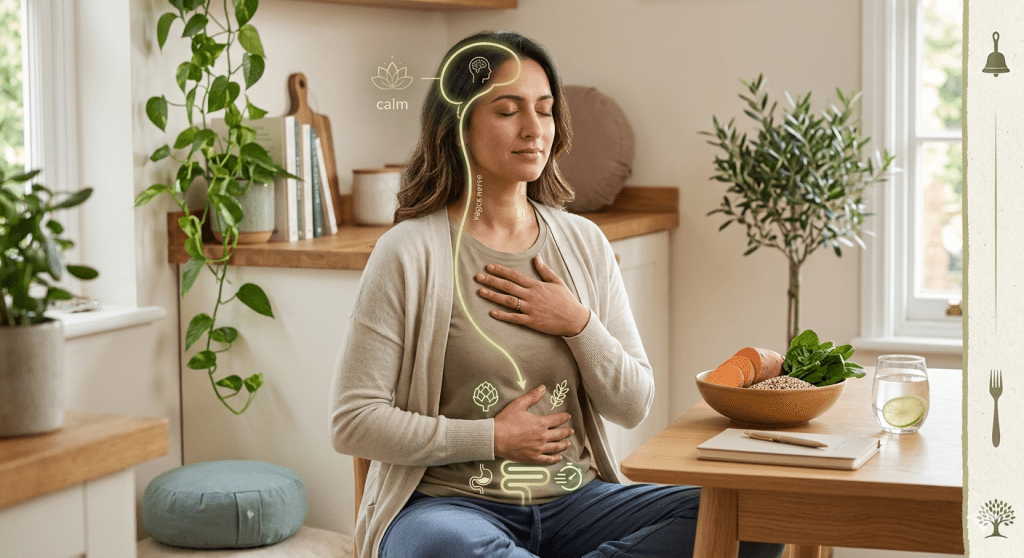
This isn’t a coincidence. It’s the Gut-Brain axis in action.

As a Nutrition and Wellness coach, I often see clients doing everything that’s right on paper like: tracking macros, eating whole grains, and staying hydrating. Yet they still feel bloated, sluggish, or unsatisfied. Often, the missing link isn’t on their plate; it’s in their nervous system.

The Science: Rest & Digest vs. Fight or Flight

Our bodies have two main settings for the nervous system:

1. Sympathetic (Fight or Flight): Designed for survival. When you’re stressed, your body diverts energy away from non-essential functions like digestion and sends it to your limbs so you can run or fight.

2. Parasympathetic (Rest and Digest): This is where the magic happens. In this state, your body produces digestive enzymes, moves food efficiently through the gut, and absorbs nutrients effectively.

The Problem: In our modern world, we are often stuck in a low-grade Fight or Flight mode. When you eat while stressed, scrolling through emails or rushing out the door, your body physically cannot prioritize breaking down that healthy meal.

How Stress Alters Your Nutrition

When chronic stress takes the wheel, several things happen inside:

Reduced Nutrient Absorption: Stress can decrease blood flow to the digestive tract, meaning you aren’t getting the full benefit of the vitamins and minerals you’re consuming.

Inflammation: High cortisol (the stress hormone) can irritate the gut lining, potentially leading to bloating and sensitivities.

• The Speed of Digestion: Stress can either slow things down leading to constipation or speed them up too much (leading to malabsorption).

The Solution: Meditation as a Digestive Aid

This is where the Inside Out approach becomes your secret weapon. You don’t need an hour of silence to fix your digestion; you just need to signal to your brain that you are safe.

The Mindful Minute Practice:

Before your next meal, try this:

1. Sit down (don’t eat standing up!).

2. Take three deep, belly breaths. Exhale longer than you inhale.

3. Look at your food and acknowledge the colors and smells.

This simple act of mindfulness flips the switch from Sympathetic to Parasympathetic. You aren’t just eating; you’re nourishing.