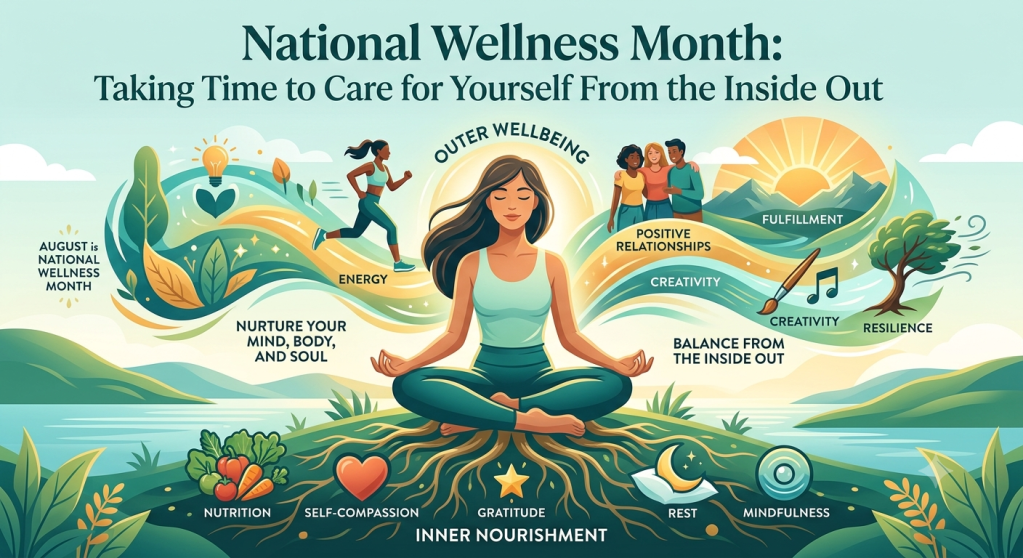
National Wellness Month: Taking Time to Care for Yourself From the Inside Out.

August is National Wellness Month, a wonderful opportunity to pause, reflect, and think about how we are really looking after ourselves.

With the pace of everyday life, it is easy to get caught up in work, responsibilities, and endless to-do lists. We often spend so much time caring for others that we forget to check in with ourselves. But our own wellbeing matters too.

Wellness is not just about being physically healthy. It is about how we feel, how we cope with challenges, how we connect with others, and how we create balance in our lives.

At Inside Out Wellbeing, we believe that true wellbeing starts from within. When we take care of our thoughts, emotions, and bodies, we create a stronger foundation for living a more balanced and fulfilling life.

What Does Wellness Mean to You?

Wellness means something different to everyone.

For some people, it may mean having more energy and taking better care of their physical health. For others, it may mean finding calm during stressful times, improving confidence, or learning to be kinder to themselves.

Wellness is not about changing everything overnight or trying to live a perfect life. It is about making small choices every day that help us feel better and more connected to ourselves.

Looking After Your Physical Wellbeing

Our bodies do so much for us every day, yet they are often the first thing we neglect when life gets busy.

Taking care of your physical wellbeing can be simple:

  • Going for a walk and enjoying some fresh air
  • Choosing nourishing foods that make you feel good
  • Drinking enough water
  • Getting better quality sleep
  • Giving yourself time to rest

Movement does not have to be about exercise goals or pushing yourself harder. Sometimes, it is simply about enjoying the feeling of moving your body and giving yourself some time away from daily pressures.

Caring for Your Mental Health

Our minds are constantly busy — thinking, planning, worrying, and processing everything happening around us. Taking care of our mental wellbeing helps us feel more grounded and able to handle life’s ups and downs.

Simple practices that can support your mental health include:

  • Taking a few quiet moments for yourself each day
  • Spending time outdoors
  • Writing down your thoughts
  • Practising mindfulness or deep breathing
  • Taking breaks from technology and social media

Even small moments of calm can make a difference.

Making Space for Your Emotions

Our emotions are a natural part of who we are. Some days feel easier than others, and that is completely normal.

Emotional wellbeing is about allowing ourselves to experience our feelings without judgement. It means recognising when we need support, setting healthy boundaries, and treating ourselves with the same kindness we would offer to someone we care about.

Sometimes, simply acknowledging how we feel can be the first step towards feeling better.

Small Changes Can Make a Big Difference

Wellness does not have to involve huge lifestyle changes. Often, the smallest actions have the greatest impact.

This August, why not choose one small thing to focus on?

It could be:

  • Taking a few minutes each morning to slow down
  • Spending more time doing something you enjoy
  • Connecting with a friend or loved one
  • Creating a healthier routine
  • Practising gratitude for the little things

Small steps, repeated consistently, can help create lasting positive changes.

Creating a Life That Supports Your Wellbeing

National Wellness Month is a reminder that self-care is not selfish. Looking after yourself allows you to show up more fully in every area of your life.

When we feel balanced and supported, we are better able to nurture our relationships, manage challenges, and enjoy the moments that matter.

Wellbeing is not about having a perfect life. It is about creating a life where you feel connected, supported, and able to be yourself.

Final Thoughts

This National Wellness Month, take some time to reconnect with yourself.

Listen to your body. Be mindful of your thoughts. Give yourself permission to rest. Celebrate the progress you have made and remember that your wellbeing deserves attention every day — not just in August.

Wellness begins from within, and every small step you take towards caring for yourself matters.
How to Start Journaling (Even If You’ve Tried and Given Up Before)

If you’ve ever bought a beautiful notebook, written in it twice, and then felt guilty every time you walked past it  this post is for you.

Journaling is one of the most powerful tools I know for mental clarity, emotional processing, and nervous system regulation. And yet it’s one of the things women tell me they want to do but just can’t seem to make stick.

The reason it hasn’t worked yet isn’t a lack of willpower. It’s that nobody taught you how to actually do it.

Let’s change that today.

Why Journaling Works: The Science Bit.

Journaling isn’t just putting words on a page. It’s a form of emotional processing that has been studied extensively and shown to:

Reduce cortisol levels writing about your feelings helps your brain move from emotional reaction to rational processing, which physically lowers your stress response.

Improve sleep a 2018 study published in the Journal of Experimental Psychology found that writing a to-do list or brain dump before bed helped people fall asleep faster by offloading unfinished thoughts from the mind.

Support mental health expressive writing has been shown to reduce symptoms of anxiety and depression, particularly in people who tend to internalise their emotions.

Increase self-awareness  when you write consistently, patterns emerge. You begin to notice what drains you, what lights you up, and what your body is trying to tell you.

Your journal is not a diary. It is a tool for healing.

Why Most People Give Up

Before we talk about how to start, let’s talk about why it hasn’t worked before before because I hear the same reasons again and again.

“I don’t know what to write”

You sit down, pen in hand, and your mind goes completely blank. So you close the notebook and tell yourself you’ll try again tomorrow.

“I don’t have time” You imagine journaling has to be a long, elaborate ritual. It doesn’t.

“I feel silly”

You start writing and immediately feel self-conscious, as though someone is reading over your shoulder. Even when you’re completely alone.

“I’m not consistent enough”

You miss a few days and decide you’ve failed, so you stop altogether.

Every single one of these is completely normal. And every single one is solvable.

How to Actually Start

Start with just five minutes

Not thirty minutes. Not a full page. Five minutes. Set a timer, pick up your pen, and write until it goes off. That’s it. Five minutes of journaling done consistently will always beat an hour of journaling done once a month.

Write by hand, not on your phone

There is something about the physical act of handwriting that slows the brain down and creates a different quality of thought. Typing is fast and functional. Handwriting is reflective and healing. If you want the full benefit of journaling, use a pen and paper.

Don’t write for anyone but yourself

Your journal does not need to be eloquent, grammatically correct, or even coherent. It is not a performance. Nobody will ever read it. Give yourself full permission to be messy, honest, and raw.

Use a prompt if you’re stuck

You don’t need to stare at a blank page. A simple prompt gives your brain a starting point and the words tend to flow from there. I’ve included some of my favourites below.

Make it part of an existing routine

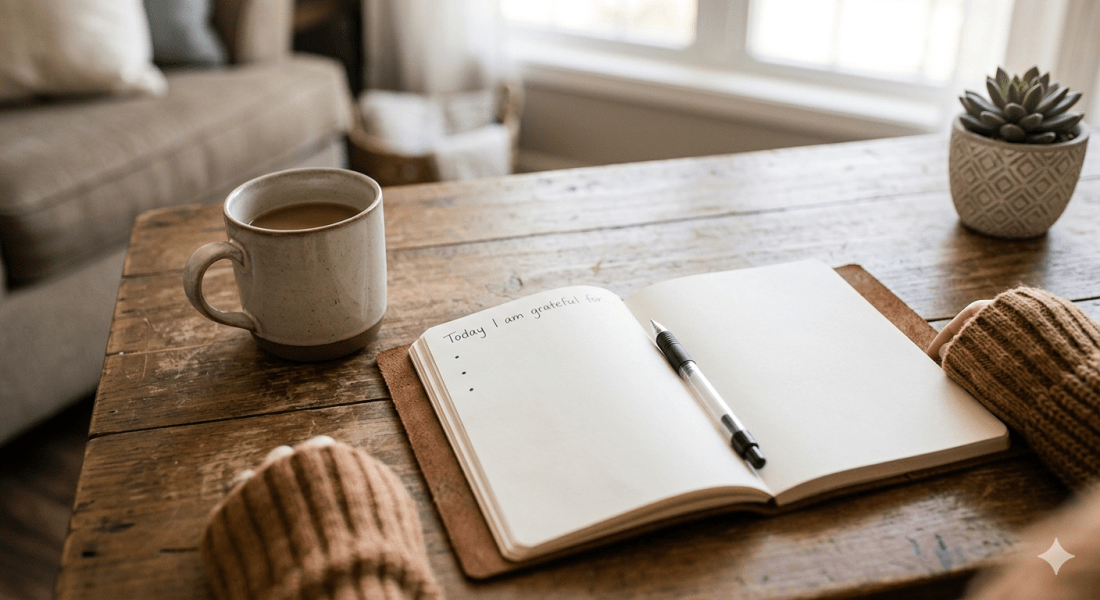
The easiest way to build a journaling habit is to attach it to something you already do. Morning coffee. Before bed. After your walk. Tuck your journal into that existing slot and it will start to feel natural within a week.

10 Journal Prompts to Get You Started

These are gentle, open-ended prompts that work whether you’re brand new to journaling or coming back after a long break.

How am I really feeling right now in my body and in my mind?

What is taking up the most space in my head today?

What do I need more of in my life right now?

What am I finding hardest at the moment, and why?

What would I tell my best friend if she was going through what I’m going through?

What am I holding onto that I need to let go of?

What has drained my energy this week? What has filled it?

What does my body need from me today?

What am I most proud of recently, however small?

What would feel really good to do for myself this week?

Pick  just one and write for five minutes without stopping.

If You’ve Tried Before and Given Up

I want to say something directly to you.

Giving up doesn’t mean journaling isn’t for you. It means you were probably trying to do too much, too perfectly, too soon.

Start smaller than feels necessary. One prompt. Five minutes. No pressure to be consistent right away. Just begin again, today, without any story about what happened last time.

The notebook doesn’t remember. And neither does your nervous system it only knows what you give it right now.

What to Do When You Miss a Day

Nothing. Absolutely nothing.

Pick up your journal the next day and carry on. Missing a day is not failure. It is just a Tuesday. The only way journaling stops working is if you stop doing it altogether and the only way that happens is if you make missing a day mean something it doesn’t.

The Invitation

You don’t need a perfect journal, a perfect routine, or a perfect mindset to begin. You just need five minutes and a pen.

Your thoughts deserve to be heard. Your feelings deserve to be processed. And you deserve the clarity, the calm, and the self-understanding that journaling can bring.

Start tonight. One prompt. Five minutes.

That’s enough.

💬 I’d love to hear from you

Are you a journaling beginner or someone coming back after a break? Which of the ten prompts are you going to try first?

Drop a comment below I read and reply to every single one. And if this post helped you, share it with a woman in your life who’s been meaning to start journaling. You might just give her the nudge she needed. 🌿

With warmth,

Leena 🌿