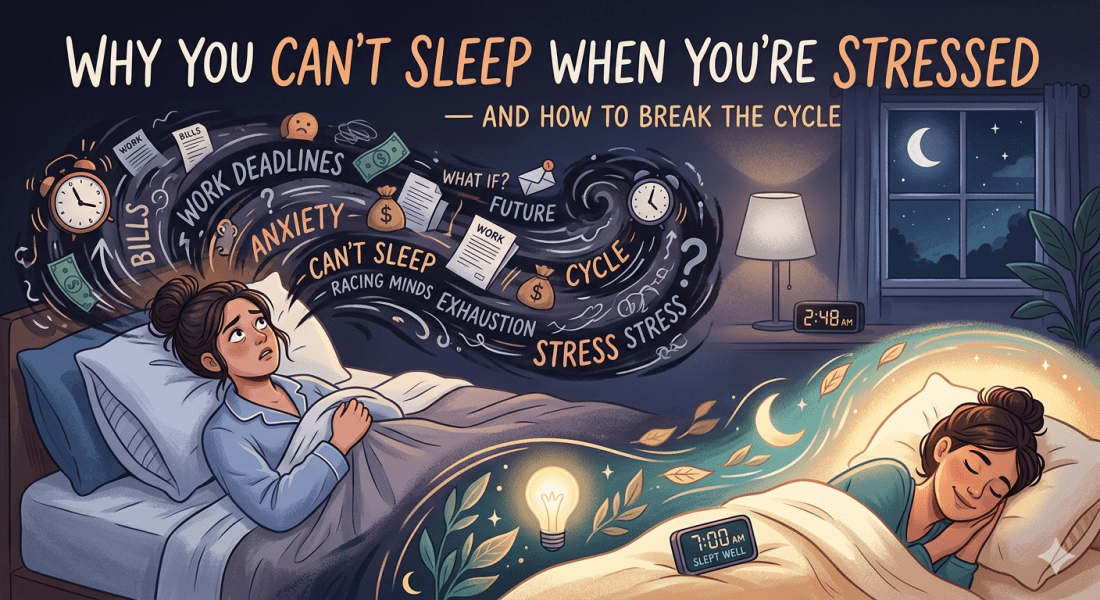
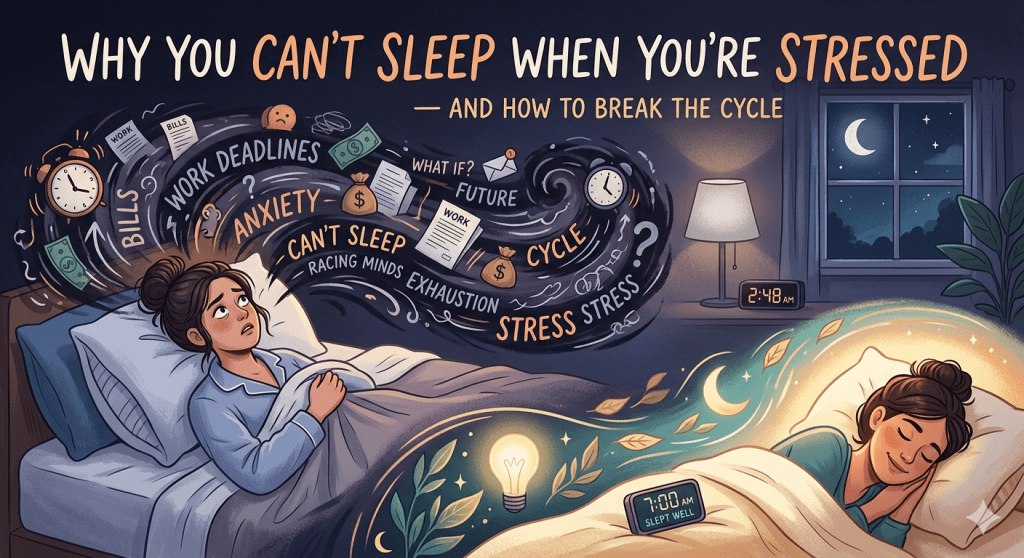
Why You Can’t Sleep When You’re Stressed and How to Break the Cycle

Let me paint a picture.

It’s 11pm. You’re exhausted. You’ve been looking forward to bed all day. And then the moment your head hits the pillow, your mind switches on. The to-do list. The conversation you keep replaying. The low hum of worry that refuses to be quiet.

Sound familiar?

You are not broken. You are not imagining it. What’s happening is a very real, very physical process inside your body and once you understand it, everything starts to make more sense.

Your Stress Response Was Never Designed for Modern Life

When your body detects stress any stress, whether it’s a physical threat or a difficult email from your manager  it activates the same ancient survival response. Cortisol and adrenaline flood your system. Your heart rate rises. Your muscles tense. Your brain sharpens into high alert.

This response was designed to help you run from danger. The problem is, your nervous system cannot tell the differe nce between a lion and a looming deadline.

And the cruel irony? This is precisely the state your body goes into when you most desperately need to sleep.

What Stress Actually Does to Your Sleep

Cortisol has a natural rhythm. It’s meant to be lowest at night that’s what makes you feel sleepy — and highest just before you wake up. But when you’re stressed, your body produces more cortisol than it should, at exactly the wrong time. It delays sleep, fragments the sleep you do get, and suppresses the deep, restorative phases your brain needs to process emotions and consolidate memories.

This is why a stressful week doesn’t just make you feel tired. It makes you feel emotionally fragile, foggy, and overwhelmed too. Sleep isn’t just rest for your body. It’s medicine for your mind.

And Then It Becomes a Cycle

Here’s where it gets particularly difficult. Poor sleep doesn’t just leave you tired it makes everything harder to cope with. Small things feel enormous. Your resilience drops. Your ability to regulate your emotions becomes compromised.

And so the very stress that kept you awake last night is now harder to manage today, because you’re running on depleted sleep. Which makes tonight harder. Which makes tomorrow harder.

This is the sleep-stress cycle. And so many women I speak to are living inside it without realising it has a name or a way out.

How to Gently Break the Cycle

You cannot force sleep. But you can create the conditions that make it possible.

Stop fighting the wakefulness. When you lie awake getting frustrated that you’re not asleep, you add another layer of stress onto an already activated nervous system. Try reframing bedtime as rest time. Even simply lying still, in the dark, is giving your body something it needs.

Give yourself a proper wind-down window. Your nervous system needs at least an hour to begin shifting from sympathetic (fight or flight) into parasympathetic (rest and digest) mode. Dim the lights. Step away from screens. Make something warm to drink. Signal to your body that the day is over.

Write it down before you lie down. Your brain holds onto unfinished thoughts to make sure you don’t forget them. A simple brain dump everything on your mind, onto paper gives your mind permission to let go. It doesn’t need to hold on if it’s already written.

Look at your cortisol triggers during the day. Skipping meals, too much caffeine, never taking a proper break — all of these keep cortisol elevated, which makes night-time winding down much harder. Eating regular meals with protein and fibre, moving your body gently, and building even ten minutes of genuine stillness into your day can make a real difference to how you sleep that night.

Be kind to yourself when sleep doesn’t come. Self-blame and frustration are themselves stressors. They raise cortisol. The most counterintuitive thing you can do and often the most effective is to release the pressure entirely.

When to Speak to Someone

If you’re regularly lying awake, waking repeatedly in the night, or finding that stress feels unmanageable, please don’t suffer in silence. Your GP can rule out any physical causes, and a qualified practitioner can support you in addressing the root of what’s driving the cycle.

You deserve sleep. You deserve rest. And you deserve to feel well not just surviving, but genuinely, deeply okay.

💬 I’d Love to Hear From You

Which comes first for you the stress or the sleeplessness? And which part of breaking the cycle feels hardest right now?

Drop your thoughts in the comments below. I read and reply to every single one.

With warmth,

Leena 🌿
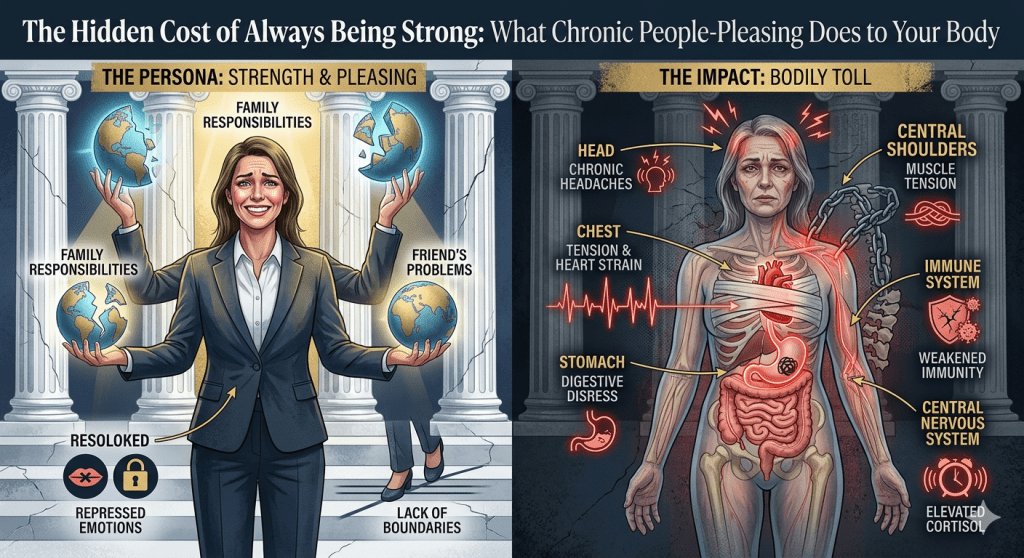
The Hidden Cost of Always Being Strong: What Chronic People-Pleasing Does to Your Body

There is a particular kind of exhaustion that comes from

always being the strong one.

The one who holds everything together. The one who says yes when she means no. The one who manages everyone else’s feelings before she even checks in with her own.

If you recognise yourself in those words this post is for you.

People-pleasing isn’t a personality trait. It’s a nervous system response.

Most of us learn to people-please very early in life. We discover that keeping others happy keeps us safe from conflict, from disapproval, from being seen as difficult or too much. Over time, this becomes automatic. We stop asking ourselves what we want and need. We simply respond to what others seem to require of us.

What we don’t realise is that this constant monitoring this hypervigilance to other people’s moods and needs is exhausting the nervous system on a profound level.

Your nervous system cannot distinguish between physical danger and social threat. Disapproval, conflict, and disappointing others all register as danger signals. And your body responds accordingly raising cortisol, tightening your muscles, heightening your alertness. Every single time.

When this happens repeatedly across an entire lifetime, the body starts to pay a price.


What chronic people-pleasing does to your body


It keeps cortisol chronically elevated.

Cortisol is your primary stress hormone. In short bursts it’s helpful. But when it’s elevated day after day because you’re constantly anticipating other people’s reactions, managing their feelings, bracing for conflict it begins to suppress your immune system, disrupt your sleep, and contribute to that bone-deep exhaustion that no amount of rest seems to fix.

It disconnects you from your own hunger and needs


When you spend your life attending to what everyone else wants, you stop noticing what you want. Many chronic people-pleasers struggle to identify their own hunger, their own preferences, their own emotions. The body’s signals become quiet and eventually, you stop hearing them altogether.


It creates chronic muscle tension

Always being on always performing okayness, always managing the atmosphere in a room requires the body to be in a constant state of readiness. The jaw clenches. The shoulders rise. The stomach tightens. Over time, this tension becomes the baseline. You forget what it feels like to be truly at ease in your own body.


It depletes your energy at a cellular level


Emotional labour the constant work of managing relationships, smoothing things over, anticipating needs is genuinely physically tiring. It consumes glucose, elevates cortisol, and taxes the same physiological systems as physical exertion. The tiredness you feel is real. It is not weakness. It is the cost of years of invisible work.


What begins to help


The path out of chronic people-pleasing is not about suddenly becoming selfish or cold. It’s about learning to include yourself in the circle of people whose needs matter.

It begins with noticing. Noticing when you say yes and mean no. Noticing the tightening in your chest when someone asks something of you that you don’t want to give. Noticing the relief you feel even briefly when you allow yourself to choose yourself.

It continues with practice. Saying no to one small thing. Pausing before you automatically agree. Asking yourself before you respond to anyone else what do I actually need right now?


It deepens with support. Because unlearning a lifetime of conditioning is not something you should have to do alone.

You are allowed to have needs, Leena 🌿
You are allowed to be tired.


You are allowed to take up space.


💬 Does this resonate with you? I’d love to hear your thoughts in the comments below. And if this post spoke to you, please share it with a woman in your life who needs to hear it today.


With warmth,
Leena 🌿

Subscribe at the bottom of the page for weekly posts on nervous system health, nutrition, and holistic wellbeing.

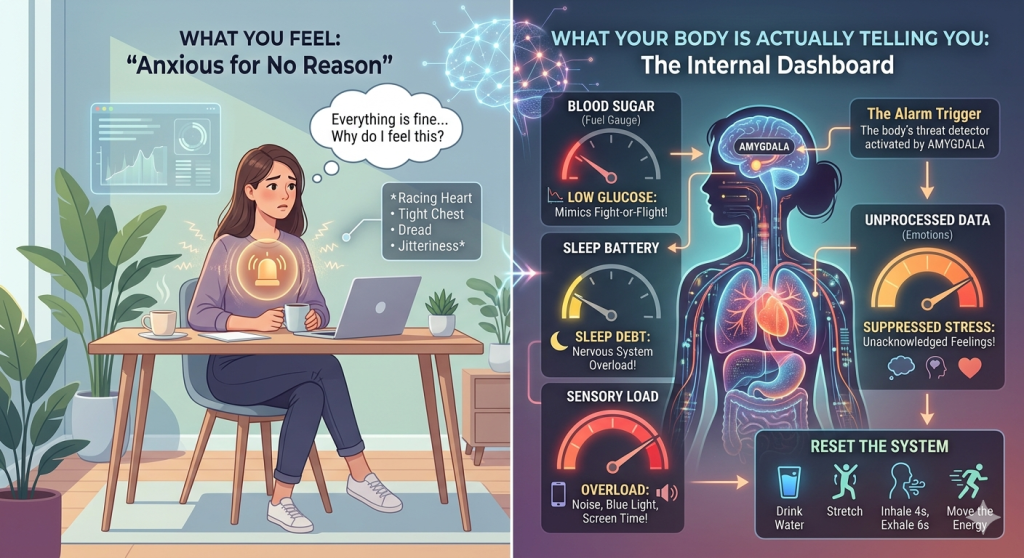
Why You Feel Anxious for No Reason — and What Your Body Is Actually Trying to Tell You

Have you ever woken up with that low-level feeling of dread, a tightness in your chest, a flutter of anxiety and had absolutely no idea why?

No big event coming up. Nothing obviously wrong. Just that quiet, constant hum of unease that follows you through the day.

You’re not imagining it. And you’re not broken. But what’s happening inside your body might surprise you.
Anxiety isn’t always in your mind

We tend to think of anxiety as a psychological problem, something to do with our thoughts, our worries, our mindset. And sometimes it is. But very often, what we experience as anxiety is actually a physiological response happening in the body completely independent of what we’re consciously thinking about.

Your nervous system is constantly scanning for danger. It doesn’t distinguish between a physical threat and an emotional one. A difficult conversation, a long to-do list, a blood sugar crash, chronic inflammation, poor sleep, too much caffeine all of these register as stress signals in your body. And your body responds the same way it always has: by releasing cortisol and adrenaline, raising your heart rate, and putting you on high alert.

That feeling? That is anxiety. And it started in your body, not your mind.

4 physical reasons you might feel anxious for no reason

1. Your blood sugar is unstable

This is one of the most underestimated causes of anxiety. When your blood sugar drops from skipping meals, eating refined carbs alone, or relying on caffeine our body releases cortisol to compensate. Cortisol raises your blood sugar again, but it also creates that familiar feeling of jitteriness, racing thoughts, and a sense that something is wrong.

If your anxiety tends to peak mid-morning or mid-afternoon, blood sugar instability could be the root cause.

2. Your nervous system is in chronic overdrive

Your nervous system has two settings: sympathetic (fight or flight) and parasympathetic (rest and digest). Most of us are living permanently in sympathetic mode checking phones first thing in the morning, never fully switching off, moving from one demand to the next without space to breathe.

When your nervous system never gets to rest, it starts to misfire. It registers ordinary situations as threats. And the result is that constant background anxiety that you can’t quite explain.

3. You’re not getting enough magnesium

Magnesium plays a crucial role in regulating the nervous system. It supports the production of GABA, the neurotransmitter that calms the brain down. When magnesium levels are low, the nervous system becomes hypersensitive and anxiety increases.

Most women are deficient in magnesium, particularly those under chronic stress, because stress depletes magnesium rapidly. Dark leafy greens, pumpkin seeds, dark chocolate, and almonds are among the richest dietary sources.

4. You’re not processing your emotions

Unfelt emotions don’t disappear. They settle in the body as tension, tightness, and that low-level unease we so often mistake for anxiety. Women who carry a lot who manage everyone else’s needs, who suppress their own feelings to keep the peace, who never quite allow themselves to fall apart 0ften experience this kind of body-held anxiety most acutely.

The body keeps score. And eventually, it asks to be heard.

What actually helps

Eat regular meals with protein and fibre to keep your blood sugar stable. Build moments of genuine stillness into your day not scrolling, not multitasking, just breathing. Add magnesium-rich foods to your diet daily. And find safe spaces to feel what you feel — whether that’s journalling, therapy, a trusted friend, or coaching.

Anxiety is not a character flaw. It is your body communicating with you. And when you learn to listen and respond with nourishment rather than resistance everything begins to shift.

You are not too sensitive. You are not overreacting. You are a human being whose body is asking for support.

💬 Does any of this resonate with you? Which of the four causes feels most familiar? 

Drop a comment below, I read and reply to every single one.

With warmth,
Leena 🌿
Why you’re always tired? It’s not because you need more sleep.

You’re getting 7, 8, maybe even 9 hours of sleep. Yet  every single morning you wake up exhausted.

Sound familiar?

Here’s what most people don’t realise: tiredness isn’t always about sleep. In fact, for many of the women I work with, sleep isn’t the problem at all. The problem is what’s happening inside their nervous system  and their body is using exhaustion as the only way it knows how to ask for help.

Let me explain.

Your Body Is Running on empty  not  Sleep deprived. When we’re chronically stressed, our bodies produce high levels of cortisol our primary stress hormone. In small doses, cortisol is helpful. It gets us out of bed, helps us focus, and keeps us alert.

When cortisol is elevated day after day  from work pressure, emotional stress, poor nutrition, or simply never switching off your body starts to burn through its reserves at an alarming rate.

The result is a deep, bone-level exhaustion that no amount of sleep can fix.

4 Real reasons you are exhausted that has nothing to do with sleep.

Your blood sugar is on a rollercoaster skipping meals, eating refined carbs alone, or relying on caffeine to get through the day sends your blood sugar crashing and every crash triggers a cortisol spike. This cycle is quietly draining your energy all day long.

Your nervous system never fully switches off, If you’re checking your phone last thing at night, sleeping with notifications on, or mentally running through tomorrow’s to-do list in bed your nervous system is never getting the deep rest it needs. Your body may be asleep but your brain is still on duty.

You’re not eating enough magnesium

Magnesium is essential for energy production at a cellular level and most of us are deficient. Low magnesium means low energy, poor sleep quality, and higher anxiety. Dark leafy greens, pumpkin seeds, and dark chocolate are your friends here.

Your emotions are exhausting you

Emotional labour l the constant managing of feelings, relationships, and other people’s needs  is genuinely physically draining. If you’re an empath, a people pleaser, or someone who carries everyone else’s stress, your tiredness has an emotional root that needs addressing too.

What Actually Helps

Eat breakfast within 90 minutes of waking up. Make it high in  protein and fibre to stabilise blood sugar

No screens for the last 30 minutes before bed

Add magnesium rich foods daily to your diet dark chocolate, spinach and pumpkin seeds.

Build one moment of genuine stillness into your day.

Move your body gently every day  even a 10 minute walk will help.

You’re Not Lazy. You’re Depleted.

There is a difference and once you understand that difference, everything changes.

Your exhaustion is not a character flaw it’s  your body asking you for something different. Small consistent changes you nourish and regulate your nervous system and your energy will return.

💬 I’d Love to Hear From You

 Which of these 4 reasons resonates most with you right now?

Drop a comment below. I read and reply to every single one. If this post helped you feel less alone, please share it with someone who needs to hear it today. 🌿

Hit subscribe at the bottom of the page for more posts like this straight to your inbox.

With warmth,

Leena 🌿

Are You Mentally Exhausted? 7 Gentle Ways to Feel Like Yourself Again

Let me ask you something.

When was the last time you felt truly, genuinely okay?

Not just “getting through the day” okay. Not “I’ll rest at the weekend” okay. But actually calm, present, and like yourself?

If you had to think about it for a while  this post is for you.

Mental exhaustion is one of the most common things I hear about from women I speak to. And yet it’s one of the least talked about. We normalise the tiredness. We push through the anxiety. We tell ourselves everyone feels this way.

But they don’t have to and  neither do you.

Here are seven gentle, realistic ways to start feeling like yourself again — no dramatic life overhaul required.

Stop Calling It “Just Stress”

The first step to feeling better is taking your mental exhaustion seriously.

Stress is not just a feeling. It is a full-body physiological response that affects your hormones, your immune system, your digestion, and your sleep. When we dismiss it as “just stress” we stop ourselves from getting the support we actually need.

Give yourself permission to say: *“I am not okay right now, and that matters.”

That one shift changes. everything.

Breathe Before You Reach for Your Phone

Most of us wake up and immediately check our phones  flooding our nervous system with news, notifications, and other people’s lives before we’ve even had a glass of water.

Tomorrow morning, try this instead: before you pick up your phone, take five slow deep breaths. Inhale for 4 counts, exhale for 7. It takes 60 seconds and it sets your entire nervous system up for a calmer day.

Small habit. Big difference.

Eat Something Before 10am

When we’re mentally exhausted, eating is often the first thing to go. We skip breakfast, grab coffee on the run, and wonder why we feel anxious and foggy by mid-morning.

Low blood sugar triggers a cortisol spike  which feels identical to anxiety. Something as simple as eating a protein-rich breakfast before 10am can noticeably reduce anxiety levels throughout the day.

Try Greek yogurt, or even a handful of nuts. Your brain will thank you.

Say No to One Thing This Week

Mental exhaustion often comes from a life that has too much in it and not enough rest between.

You do not need to justify saying no. You do not need a reason good enough for other people. “I don’t have the capacity right now” is a complete sentence.

Pick one thing on your list this week that you can cancel, delegate, or simply let go of. Notice how it feels.

Go Outside for 10 Minutes  Without Your Phone

Nature is not a luxury. It is a genuine, research-backed tool for mental health. Even 10 minutes outside  without scrolling  lowers cortisol, reduces anxiety, and improves mood.

You don’t need a park or a forest. A garden, a street, a patch of sky. Just step outside, leave your phone behind, and let your nervous system breathe.

Talk to Someone  Anyone

One of the cruelest things about mental exhaustion is that it makes us want to isolate at exactly the moment we need connection most.

You don’t need to have a deep conversation. You don’t need to explain everything. Simply being in the presence of someone who makes you feel safe  a friend, a family member, a coach  is enough to regulate your nervous system and remind you that you are not alone.

If you don’t feel you have that person right now, I want you to know: that is more common than you think, and it is something that can change.

Give Yourself One Moment of Joy Today  On Purpose

When we are burnt out we stop doing the things that light us up. We tell ourselves we’ll do them when we have more time, more energy, more of everything.

But joy is not a reward for getting through the hard stuff. It is part of what gets you through.

Today, on purpose, do one small thing that makes you feel like you again. A walk. A favourite meal. A song you love. A chapter of a book. Ten minutes of nothing at all.

You are allowed to feel good. Even now. Especially now.

 You Are Not Too Far Gone

Whatever you are carrying right now  however long you have been running on empty I want you to know that it is possible to feel better. Not perfectly. Not all at once. But genuinely, sustainably better.

Your nervous system wants to heal. Your body wants to rest. You just need to give it permission.

 💬 I’d Love to Hear From You

Which of these seven things do you need most right now?**

Drop a comment below and let me know — I read and reply to every single one. And if this resonated with you, please share it with someone who needs to hear it today. You never know whose week you might change. 

If you’d like to read more about stress, nutrition, and nervous system health, hit subscribe at the bottom of the page to get every new post straight to your inbox.

With warmth,

Leena 🌿