

There is a particular kind of exhaustion that comes from
always being the strong one.
The one who holds everything together. The one who says yes when she means no. The one who manages everyone else’s feelings before she even checks in with her own.
If you recognise yourself in those words this post is for you.
People-pleasing isn’t a personality trait. It’s a nervous system response.
Most of us learn to people-please very early in life. We discover that keeping others happy keeps us safe from conflict, from disapproval, from being seen as difficult or too much. Over time, this becomes automatic. We stop asking ourselves what we want and need. We simply respond to what others seem to require of us.
What we don’t realise is that this constant monitoring this hypervigilance to other people’s moods and needs is exhausting the nervous system on a profound level.
Your nervous system cannot distinguish between physical danger and social threat. Disapproval, conflict, and disappointing others all register as danger signals. And your body responds accordingly raising cortisol, tightening your muscles, heightening your alertness. Every single time.
When this happens repeatedly across an entire lifetime, the body starts to pay a price.
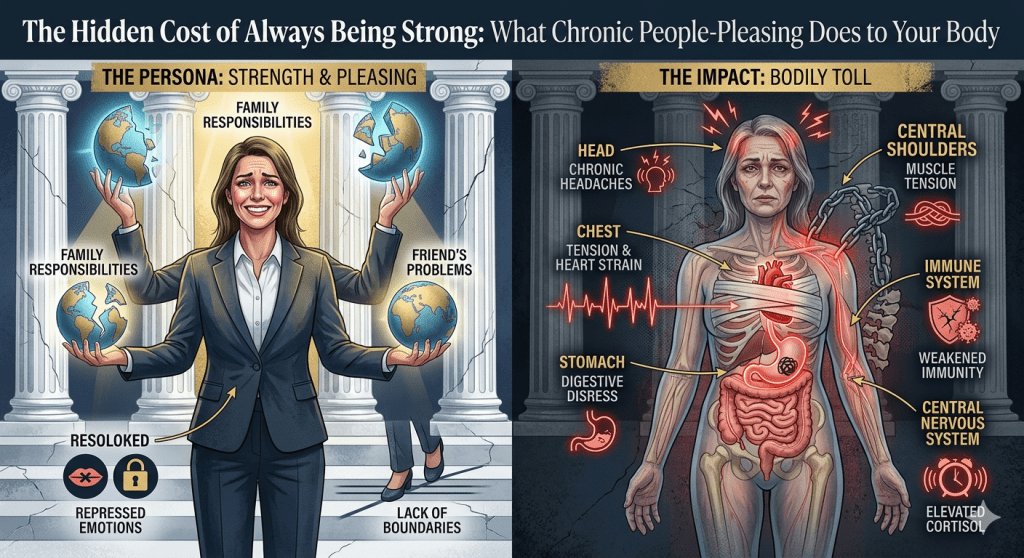
What chronic people-pleasing does to your body
It keeps cortisol chronically elevated.
Cortisol is your primary stress hormone. In short bursts it’s helpful. But when it’s elevated day after day because you’re constantly anticipating other people’s reactions, managing their feelings, bracing for conflict it begins to suppress your immune system, disrupt your sleep, and contribute to that bone-deep exhaustion that no amount of rest seems to fix.
It disconnects you from your own hunger and needs
When you spend your life attending to what everyone else wants, you stop noticing what you want. Many chronic people-pleasers struggle to identify their own hunger, their own preferences, their own emotions. The body’s signals become quiet and eventually, you stop hearing them altogether.
It creates chronic muscle tension
Always being on always performing okayness, always managing the atmosphere in a room requires the body to be in a constant state of readiness. The jaw clenches. The shoulders rise. The stomach tightens. Over time, this tension becomes the baseline. You forget what it feels like to be truly at ease in your own body.
It depletes your energy at a cellular level
Emotional labour the constant work of managing relationships, smoothing things over, anticipating needs is genuinely physically tiring. It consumes glucose, elevates cortisol, and taxes the same physiological systems as physical exertion. The tiredness you feel is real. It is not weakness. It is the cost of years of invisible work.
What begins to help
The path out of chronic people-pleasing is not about suddenly becoming selfish or cold. It’s about learning to include yourself in the circle of people whose needs matter.
It begins with noticing. Noticing when you say yes and mean no. Noticing the tightening in your chest when someone asks something of you that you don’t want to give. Noticing the relief you feel even briefly when you allow yourself to choose yourself.
It continues with practice. Saying no to one small thing. Pausing before you automatically agree. Asking yourself before you respond to anyone else what do I actually need right now?
It deepens with support. Because unlearning a lifetime of conditioning is not something you should have to do alone.
You are allowed to have needs, Leena 🌿
You are allowed to be tired.
You are allowed to take up space.
💬 Does this resonate with you? I’d love to hear your thoughts in the comments below. And if this post spoke to you, please share it with a woman in your life who needs to hear it today.
With warmth,
Leena 🌿
Subscribe at the bottom of the page for weekly posts on nervous system health, nutrition, and holistic wellbeing.
 Inside Out Wellbeing