

Nourishing Breakfasts That Take Less Than 5 Minutes (and Support Your Mood All Day)

Let’s talk about breakfast. Not in a complicated, track-your-macros way. In a simple, nourish-your-nervous-system, feel-good-all-morning way.

what you eat within the first 90 minutes of waking up sets your blood sugar — and your mood — for the entire day.

Here are three of my favourite quick, nourishing breakfasts that I genuinely make and eat myself.

1. Greek Yoghurt with Berries and Seeds

Spoon full-fat Greek yoghurt into a bowl. Add a handful of frozen berries (they defrost in minutes), a tablespoon of pumpkin seeds, and a drizzle of honey.

Why it works: The protein in the yoghurt stabilises your blood sugar. The berries are full of antioxidants that support your mood and reduce inflammation. The pumpkin seeds are one of the richest sources of magnesium the mineral most of us are deficient in and the one most linked to anxiety and poor sleep.

This breakfast takes three minutes and it genuinely changes how you feel by 11am.

2. Oats with Nut Butter and Banana

Make your porridge however you like it. Stir in a tablespoon of almond or peanut butter while it’s still warm. Slice half a banana on top.

Why it works: Oats are a slow-release carbohydrate, meaning they release energy steadily rather than spiking and crashing your blood sugar. The nut butter adds healthy fat and protein to keep you full and focused. And bananas contain tryptophan — a precursor to serotonin, your feel-good hormone.

Warm, comforting, and genuinely good for your brain chemistry.

3. Eggs on Rye Toast with Avocado

Toast one slice of rye bread. Slice a quarter of an avocado. Done.

Why it works: Avocado provides healthy monounsaturated fats that support hormone production. Rye bread is lower on the glycaemic index than white bread, so it won’t spike your blood sugar.

This is the breakfast I eat when I want to feel sharp, calm, and completely nourished.

None of these breakfasts require meal prep, complicated ingredients, or more than five minutes of your morning. They just require the decision to nourish yourself first before the emails, before the chaos, before everything else.

You are worth five minutes,

Which one are you trying this weekend? Let me know in the comments.


With warmth,
Leena 🌿
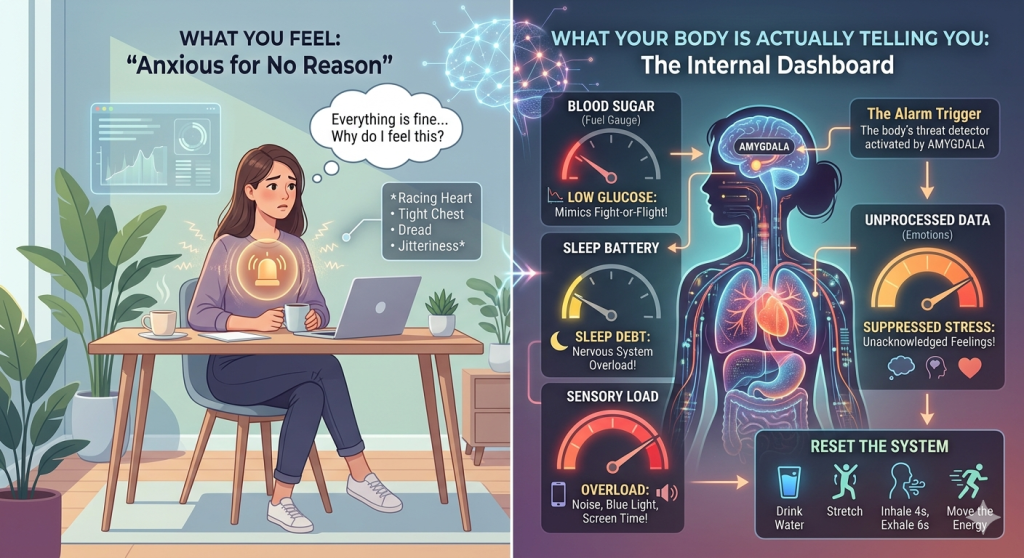
Why You Feel Anxious for No Reason — and What Your Body Is Actually Trying to Tell You

Have you ever woken up with that low-level feeling of dread, a tightness in your chest, a flutter of anxiety and had absolutely no idea why?

No big event coming up. Nothing obviously wrong. Just that quiet, constant hum of unease that follows you through the day.

You’re not imagining it. And you’re not broken. But what’s happening inside your body might surprise you.
Anxiety isn’t always in your mind

We tend to think of anxiety as a psychological problem, something to do with our thoughts, our worries, our mindset. And sometimes it is. But very often, what we experience as anxiety is actually a physiological response happening in the body completely independent of what we’re consciously thinking about.

Your nervous system is constantly scanning for danger. It doesn’t distinguish between a physical threat and an emotional one. A difficult conversation, a long to-do list, a blood sugar crash, chronic inflammation, poor sleep, too much caffeine all of these register as stress signals in your body. And your body responds the same way it always has: by releasing cortisol and adrenaline, raising your heart rate, and putting you on high alert.

That feeling? That is anxiety. And it started in your body, not your mind.

4 physical reasons you might feel anxious for no reason

1. Your blood sugar is unstable

This is one of the most underestimated causes of anxiety. When your blood sugar drops from skipping meals, eating refined carbs alone, or relying on caffeine our body releases cortisol to compensate. Cortisol raises your blood sugar again, but it also creates that familiar feeling of jitteriness, racing thoughts, and a sense that something is wrong.

If your anxiety tends to peak mid-morning or mid-afternoon, blood sugar instability could be the root cause.

2. Your nervous system is in chronic overdrive

Your nervous system has two settings: sympathetic (fight or flight) and parasympathetic (rest and digest). Most of us are living permanently in sympathetic mode checking phones first thing in the morning, never fully switching off, moving from one demand to the next without space to breathe.

When your nervous system never gets to rest, it starts to misfire. It registers ordinary situations as threats. And the result is that constant background anxiety that you can’t quite explain.

3. You’re not getting enough magnesium

Magnesium plays a crucial role in regulating the nervous system. It supports the production of GABA, the neurotransmitter that calms the brain down. When magnesium levels are low, the nervous system becomes hypersensitive and anxiety increases.

Most women are deficient in magnesium, particularly those under chronic stress, because stress depletes magnesium rapidly. Dark leafy greens, pumpkin seeds, dark chocolate, and almonds are among the richest dietary sources.

4. You’re not processing your emotions

Unfelt emotions don’t disappear. They settle in the body as tension, tightness, and that low-level unease we so often mistake for anxiety. Women who carry a lot who manage everyone else’s needs, who suppress their own feelings to keep the peace, who never quite allow themselves to fall apart 0ften experience this kind of body-held anxiety most acutely.

The body keeps score. And eventually, it asks to be heard.

What actually helps

Eat regular meals with protein and fibre to keep your blood sugar stable. Build moments of genuine stillness into your day not scrolling, not multitasking, just breathing. Add magnesium-rich foods to your diet daily. And find safe spaces to feel what you feel — whether that’s journalling, therapy, a trusted friend, or coaching.

Anxiety is not a character flaw. It is your body communicating with you. And when you learn to listen and respond with nourishment rather than resistance everything begins to shift.

You are not too sensitive. You are not overreacting. You are a human being whose body is asking for support.

💬 Does any of this resonate with you? Which of the four causes feels most familiar? 

Drop a comment below, I read and reply to every single one.

With warmth,
Leena 🌿