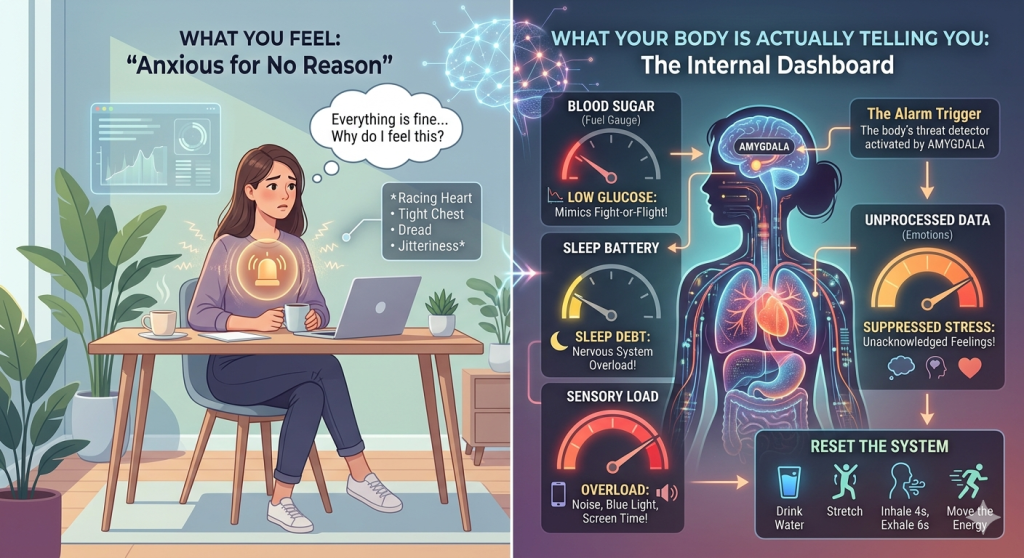
Why You Feel Anxious for No Reason — and What Your Body Is Actually Trying to Tell You

Have you ever woken up with that low-level feeling of dread, a tightness in your chest, a flutter of anxiety and had absolutely no idea why?

No big event coming up. Nothing obviously wrong. Just that quiet, constant hum of unease that follows you through the day.

You’re not imagining it. And you’re not broken. But what’s happening inside your body might surprise you.
Anxiety isn’t always in your mind

We tend to think of anxiety as a psychological problem, something to do with our thoughts, our worries, our mindset. And sometimes it is. But very often, what we experience as anxiety is actually a physiological response happening in the body completely independent of what we’re consciously thinking about.

Your nervous system is constantly scanning for danger. It doesn’t distinguish between a physical threat and an emotional one. A difficult conversation, a long to-do list, a blood sugar crash, chronic inflammation, poor sleep, too much caffeine all of these register as stress signals in your body. And your body responds the same way it always has: by releasing cortisol and adrenaline, raising your heart rate, and putting you on high alert.

That feeling? That is anxiety. And it started in your body, not your mind.

4 physical reasons you might feel anxious for no reason

1. Your blood sugar is unstable

This is one of the most underestimated causes of anxiety. When your blood sugar drops from skipping meals, eating refined carbs alone, or relying on caffeine our body releases cortisol to compensate. Cortisol raises your blood sugar again, but it also creates that familiar feeling of jitteriness, racing thoughts, and a sense that something is wrong.

If your anxiety tends to peak mid-morning or mid-afternoon, blood sugar instability could be the root cause.

2. Your nervous system is in chronic overdrive

Your nervous system has two settings: sympathetic (fight or flight) and parasympathetic (rest and digest). Most of us are living permanently in sympathetic mode checking phones first thing in the morning, never fully switching off, moving from one demand to the next without space to breathe.

When your nervous system never gets to rest, it starts to misfire. It registers ordinary situations as threats. And the result is that constant background anxiety that you can’t quite explain.

3. You’re not getting enough magnesium

Magnesium plays a crucial role in regulating the nervous system. It supports the production of GABA, the neurotransmitter that calms the brain down. When magnesium levels are low, the nervous system becomes hypersensitive and anxiety increases.

Most women are deficient in magnesium, particularly those under chronic stress, because stress depletes magnesium rapidly. Dark leafy greens, pumpkin seeds, dark chocolate, and almonds are among the richest dietary sources.

4. You’re not processing your emotions

Unfelt emotions don’t disappear. They settle in the body as tension, tightness, and that low-level unease we so often mistake for anxiety. Women who carry a lot who manage everyone else’s needs, who suppress their own feelings to keep the peace, who never quite allow themselves to fall apart 0ften experience this kind of body-held anxiety most acutely.

The body keeps score. And eventually, it asks to be heard.

What actually helps

Eat regular meals with protein and fibre to keep your blood sugar stable. Build moments of genuine stillness into your day not scrolling, not multitasking, just breathing. Add magnesium-rich foods to your diet daily. And find safe spaces to feel what you feel — whether that’s journalling, therapy, a trusted friend, or coaching.

Anxiety is not a character flaw. It is your body communicating with you. And when you learn to listen and respond with nourishment rather than resistance everything begins to shift.

You are not too sensitive. You are not overreacting. You are a human being whose body is asking for support.

💬 Does any of this resonate with you? Which of the four causes feels most familiar? 

Drop a comment below, I read and reply to every single one.

With warmth,
Leena 🌿

The Gut-Mental Health Connection: Why Your Stomach Holds the Key to Your Mood

Have you ever had a gut feeling about something? 

Felt butterflies before a big moment? Noticed your stomach tighten when you’re anxious, or felt nauseous when you’re scared?

That is not a coincidence. That is your gut and your brain in constant, real-time conversation and what’s happening in your digestive system has a profound effect on your mental health, your mood, and your ability to cope with stress.

Have you ever had a gut feeling about something? 

Felt butterflies before a big moment? Noticed your stomach tighten when you’re anxious, or felt nauseous when you’re scared?

That is not a coincidence. That is your gut and your brain in constant, real-time conversation and what’s happening in your digestive system has a profound effect on your mental health, your mood, and your ability to cope with stress.

This is one of the most exciting areas of nutrition science right now, and it could completely change how you think about your mental wellbeing.

Meet Your Second Brain

Your gut contains over 500 million neuron’s more than your spinal cord. Scientists now call it the “enteric nervous system” or your second brain, and it operates largely independently of the brain in your head.

But here’s the part that surprises most people: approximately 90% of your serotonin  your primary feel good neurotransmitter  is produced in your gut and not your brain.

This means that the health of your digestive system directly impacts your mood, your anxiety levels, your sleep, and your emotional resilience.

What Damages Your Gut-Mental Health Connection

Chronic stress: cortisol disrupts your gut microbiome, reducing the diversity of beneficial bacteria.

Ultra-processed foods:  sugar, artificial sweeteners, and refined carbs feed harmful bacteria and reduce serotonin production

Antibiotics  while sometimes necessary, they wipe out both harmful and beneficial gut bacteria

Not enough fibre: Your  beneficial gut bacteria feeds on fibre., without it, they would starve.

Eating too fast: your gut needs a calm, parasympathetic state to digest properly. Eating on the go or under stress impairs digestion significantly.

5 Ways to Nourish Your Gut for Better Mental Health.

Eat fermented foods daily; Yogurt, kefir, sauerkraut, kimchi, and miso are all rich in beneficial probiotics that support a healthy microbiome and better mood regulation.

Increase your fibre intake; Aim for a wide variety of plant foods  vegetables, fruits, legumes, wholegrains, nuts and seeds. Each different plant feeds a different strain of beneficial bacteria.

Reduce ultra-processed foods

This doesn’t mean perfection. It means gradually crowding out the processed foods with more whole, nourishing alternatives.

Eat slowly and mindfully

Chew your food properly. Sit down to eat. Take three deep breaths before your meal to shift your nervous system into rest and digest mode. Your gut absorbs nutrients far more effectively in a calm state.

Manage your stress

Since stress directly damages your gut microbiome, nervous system regulation isn’t just good for your mind  it’s essential for your gut health too.

The Beautiful Truth

You cannot separate mental health from physical health. They are the same conversation, happening in the same body.

When you nourish your gut, you nourish your mind. When you calm your nervous system, you improve your digestion. When you eat well, you feel better emotionally. Everything is connected  and that is genuinely good news, because it means every small positive choice you make ripples through your entire wellbeing.

💬 I’d Love to Hear From You

Did you know that 90% of serotonin is made in the gut? Does that change how you think about what you eat?

Leave a comment below 

 I’d love to know your thoughts. And if this post opened your eyes to the gut-brain connection, share it with someone who might need to hear it.

Hit subscribe at the bottom of the page to get every new post straight to your inbox.

With warmth,

Leena 🌿

Nutrition & Wellness Coach | Inside Out Wellbeing

Are You Mentally Exhausted? 7 Gentle Ways to Feel Like Yourself Again

Let me ask you something.

When was the last time you felt truly, genuinely okay?

Not just “getting through the day” okay. Not “I’ll rest at the weekend” okay. But actually calm, present, and like yourself?

If you had to think about it for a while  this post is for you.

Mental exhaustion is one of the most common things I hear about from women I speak to. And yet it’s one of the least talked about. We normalise the tiredness. We push through the anxiety. We tell ourselves everyone feels this way.

But they don’t have to and  neither do you.

Here are seven gentle, realistic ways to start feeling like yourself again — no dramatic life overhaul required.

Stop Calling It “Just Stress”

The first step to feeling better is taking your mental exhaustion seriously.

Stress is not just a feeling. It is a full-body physiological response that affects your hormones, your immune system, your digestion, and your sleep. When we dismiss it as “just stress” we stop ourselves from getting the support we actually need.

Give yourself permission to say: *“I am not okay right now, and that matters.”

That one shift changes. everything.

Breathe Before You Reach for Your Phone

Most of us wake up and immediately check our phones  flooding our nervous system with news, notifications, and other people’s lives before we’ve even had a glass of water.

Tomorrow morning, try this instead: before you pick up your phone, take five slow deep breaths. Inhale for 4 counts, exhale for 7. It takes 60 seconds and it sets your entire nervous system up for a calmer day.

Small habit. Big difference.

Eat Something Before 10am

When we’re mentally exhausted, eating is often the first thing to go. We skip breakfast, grab coffee on the run, and wonder why we feel anxious and foggy by mid-morning.

Low blood sugar triggers a cortisol spike  which feels identical to anxiety. Something as simple as eating a protein-rich breakfast before 10am can noticeably reduce anxiety levels throughout the day.

Try Greek yogurt, or even a handful of nuts. Your brain will thank you.

Say No to One Thing This Week

Mental exhaustion often comes from a life that has too much in it and not enough rest between.

You do not need to justify saying no. You do not need a reason good enough for other people. “I don’t have the capacity right now” is a complete sentence.

Pick one thing on your list this week that you can cancel, delegate, or simply let go of. Notice how it feels.

Go Outside for 10 Minutes  Without Your Phone

Nature is not a luxury. It is a genuine, research-backed tool for mental health. Even 10 minutes outside  without scrolling  lowers cortisol, reduces anxiety, and improves mood.

You don’t need a park or a forest. A garden, a street, a patch of sky. Just step outside, leave your phone behind, and let your nervous system breathe.

Talk to Someone  Anyone

One of the cruelest things about mental exhaustion is that it makes us want to isolate at exactly the moment we need connection most.

You don’t need to have a deep conversation. You don’t need to explain everything. Simply being in the presence of someone who makes you feel safe  a friend, a family member, a coach  is enough to regulate your nervous system and remind you that you are not alone.

If you don’t feel you have that person right now, I want you to know: that is more common than you think, and it is something that can change.

Give Yourself One Moment of Joy Today  On Purpose

When we are burnt out we stop doing the things that light us up. We tell ourselves we’ll do them when we have more time, more energy, more of everything.

But joy is not a reward for getting through the hard stuff. It is part of what gets you through.

Today, on purpose, do one small thing that makes you feel like you again. A walk. A favourite meal. A song you love. A chapter of a book. Ten minutes of nothing at all.

You are allowed to feel good. Even now. Especially now.

 You Are Not Too Far Gone

Whatever you are carrying right now  however long you have been running on empty I want you to know that it is possible to feel better. Not perfectly. Not all at once. But genuinely, sustainably better.

Your nervous system wants to heal. Your body wants to rest. You just need to give it permission.

 💬 I’d Love to Hear From You

Which of these seven things do you need most right now?**

Drop a comment below and let me know — I read and reply to every single one. And if this resonated with you, please share it with someone who needs to hear it today. You never know whose week you might change. 

If you’d like to read more about stress, nutrition, and nervous system health, hit subscribe at the bottom of the page to get every new post straight to your inbox.

With warmth,

Leena 🌿

3-3-3 Rule: Practical Technique for Anxiety Relief

Do you ever find yourself trapped in a whirlwind of anxious thoughts, unable to break free from the cycle of worry and stress? In the fast-paced world we live in, anxiety has become an all too common companion for many of us. But what if I told you there’s a simple yet powerful technique that could help you find calm amidst the chaos? Enter the 3-3-3 rule – a game-changing strategy for managing anxiety and reclaiming your peace of mind.

What is the 3-3-3 Rule?

The 3-3-3 rule is a straightforward method designed to ground you in the present moment and alleviate feelings of anxiety. It consists of three steps, each involving the senses, to bring you back to a state of equilibrium:

Name Three Things You See: 

Start by observing your surroundings and identifying three things you can see. It could be anything from the texture of the walls to the colour of the sky. By focusing on the present moment, you shift your attention away from anxious thoughts and anchor yourself in reality.

Acknowledge Three Sounds You Hear: 

Tune in to the sounds around you and identify three distinct noises. It might be the hum of traffic outside your window or the gentle rustling of leaves in the wind. Listening attentively to the present soundscape helps quieten the noise in your mind and promote a sense of calm.

Move Three Parts of Your Body: 

Engage your body by moving three different parts – perhaps wiggle your toes, roll your shoulders, or stretch your arms. Physical movement not only releases tension but also redirects your focus away from anxious feelings and towards the sensations of your body in motion.

Why Does It Work?

The brilliance of the 3-3-3 rule lies in its simplicity and effectiveness. By engaging multiple senses and incorporating physical movement, it interrupts the cycle of anxious rumination and brings your awareness back to the present moment. This mindfulness practice is rooted in the principles of grounding techniques, which aim to anchor you in the here and now, away from the spiralling thoughts of the past or future.

How to Incorporate the 3-3-3 Rule into Your Life

The beauty of the 3-3-3 rule is its versatility – you can use it anytime, anywhere, whenever you feel overwhelmed by anxiety. Whether you’re at work, in the grocery store, or lying in bed at night, this technique is always at your disposal. With regular practice, it becomes a valuable tool in your mental health toolkit, helping you navigate life’s challenges with greater ease and resilience.

Join the Movement

The 3-3-3 rule is more than just a coping strategy – it’s a mindset shift towards greater self-awareness and emotional well-being. As more people discover its transformative power, the 3-3-3 rule is quickly gaining traction as a viral trend in the realm of mental health and self-care. Join the movement today and take the first step towards a calmer, more grounded existence.

The 3-3-3 rule offers a simple yet profound antidote to anxiety, inviting you to reconnect with the present moment and reclaim control over your mental state. So the next time you feel overwhelmed by worry or stress, remember the power of three – see, hear, move – and watch as your anxiety melts away, leaving behind a newfound sense of peace and clarity.

Incorporating the 3-3-3 rule into your daily routine can be a transformative practice for cultivating inner peace amidst the chaos of everyday life. Imagine starting your day with three minutes of deep breathing exercises, allowing yourself to centre and ground before diving into the demands of the day. Throughout the day, take three brief breaks to check in with yourself, perhaps through a quick mindfulness exercise or a simple stretch to release tension. Finally, before bed, dedicate another three minutes to reflection, journaling, or gratitude practice, easing your mind and preparing for restorative sleep. By consistently integrating these small yet impactful moments into your routine, you can gradually rewire your brain to respond to stress with calmness and resilience. Remember, it’s the consistency and commitment to these practices that truly unlock their transformative power in promoting mental well-being.